
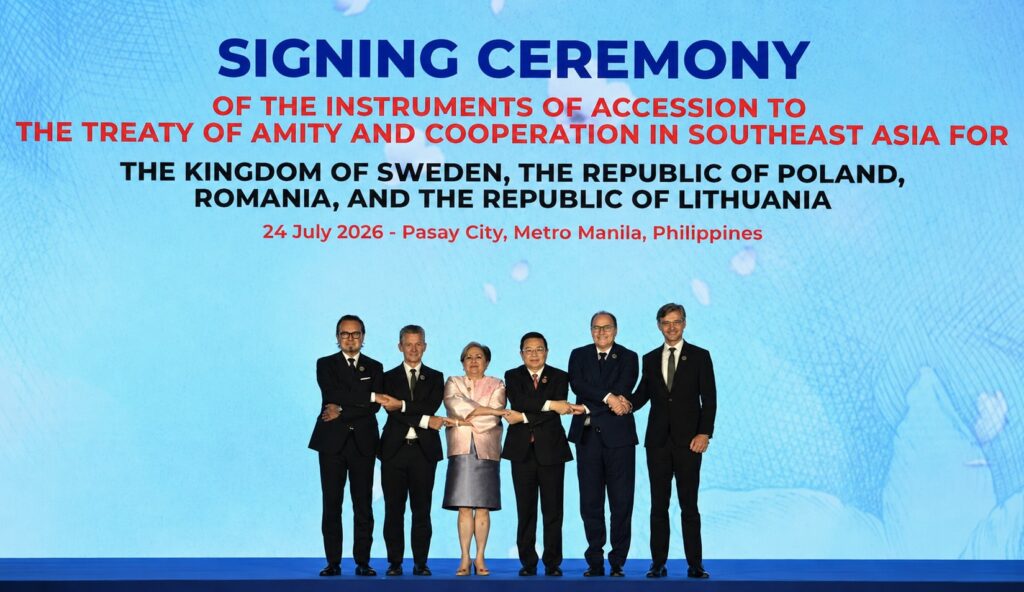
MANILA, Philippines — Sweden, Poland, Romania and Lithuania formally joined the Treaty of Amity and Cooperation in Southeast Asia on Friday, giving four European Union members a new diplomatic foothold in one of the world’s most economically important—and strategically contested—regions.
The countries signed their instruments of accession in Manila on the sidelines of the 59th ASEAN Foreign Ministers’ Meeting. Their entry brought the treaty’s membership to 62 contracting parties, according to the ASEAN Secretariat.
The agreement, commonly known as the TAC, commits its parties to respect national sovereignty, territorial integrity and political independence; refrain from interfering in domestic affairs; renounce threats and force; and resolve disputes peacefully.
The four countries did not join ASEAN itself. They received no voting rights in the regional organization, trade privileges or military guarantees. Instead, accession places them within ASEAN’s expanding diplomatic network and offers a foundation for closer political, economic and technical cooperation.
A Wider European Turn Toward Southeast Asia
The accessions reflect Europe’s growing attention to Southeast Asia as governments seek new markets, more resilient supply chains and partnerships in energy, technology and security.
Lithuania has been particularly explicit about its intentions. Foreign Minister Kęstutis Budrys previously identified high technology, energy security, digital government and infrastructure as areas for cooperation. Lithuanian officials have also presented respect for sovereignty and territorial integrity as a shared interest shaped partly by Russia’s invasion of Ukraine.
For Poland and Romania, two NATO members on the alliance’s eastern flank, the treaty similarly provides an opportunity to connect European security concerns with debates over international law in the Indo-Pacific. Sweden’s accession complements its broader engagement in Asian defense, innovation and sustainable development.
But the move should not be interpreted as a new European security alliance in Asia. The treaty creates no collective-defense obligation and does not alter the countries’ commitments to NATO or the European Union.
Manila Welcomes a Vote of Confidence
Philippine Foreign Affairs Secretary Theresa Lazaro described the four accessions as evidence that the treaty’s principles had moved beyond their Southeast Asian origins.
“The diversity of the countries represented here today speaks volumes,” she said, pointing to the participation of Nordic, Baltic and Central European governments. Philippine officials portrayed the ceremony as an endorsement of ASEAN’s role in maintaining a rules-based regional order.
President Ferdinand Marcos Jr., marking the treaty’s 50th anniversary, argued that peace must be patiently built and collectively sustained. The Philippines also designated July 24 as a day of commemoration for the pact, which was signed in Bali in 1976.
For Manila, however, the ceremony carried significance beyond diplomatic symbolism.
The accessions occurred as confrontations between Philippine and Chinese vessels intensified in the South China Sea. On the same day, the Philippines accused the Chinese Coast Guard of again using water cannons against Philippine vessels near Scarborough Shoal. China said it had taken lawful measures against ships operating in waters it claims.
The timing exposed a central tension surrounding the treaty: China is itself a contracting party, having acceded in 2003, yet Beijing and Manila continue to disagree sharply over maritime rights and the meaning of international law.
Binding Principles, Limited Enforcement
ASEAN calls the TAC a legally binding code for interstate conduct. Its influence, however, depends largely on diplomacy, reputation and voluntary compliance rather than a strong enforcement system.
That limitation mirrors ASEAN’s wider approach. Decisions are generally based on consensus, while noninterference and quiet negotiation are favored over sanctions or public confrontation. Supporters argue that this method keeps dialogue open among governments with very different political systems. Critics say it can produce broad declarations without an effective response when those principles are challenged.
The treaty nevertheless carries political weight. Accession requires the consent of ASEAN members, and participation is often treated as an entry point for countries seeking closer institutional relations with the bloc.
New guidelines adopted at the July ministerial meeting allow contracting parties to propose and finance ASEAN cooperation projects. Possible initiatives can cover economic development, digital transformation, environmental policy and other ASEAN priorities, although each proposal remains voluntary and subject to the bloc’s approval.
A Diplomatic Gain—With a Test Still Ahead
For ASEAN, the four signatures represent international recognition at a moment when the organization is trying to preserve its influence amid competition involving China, the United States, Europe, Japan and other powers.
For the European signatories, accession offers access and visibility without requiring them to choose sides in that competition. It allows them to support sovereignty, peaceful dispute settlement and ASEAN’s institutional leadership while pursuing practical interests in trade, cybersecurity, energy and infrastructure.
The immediate impact will be modest. Tariffs will not fall because of the treaty, investment will not automatically increase, and regional disputes will not become easier to resolve.
Its longer-term value will depend on whether the four governments turn the diplomatic gesture into sustained engagement—and whether all 62 parties apply the principles they have formally promised to uphold.
Sources: Reuters, ASEAN Secretariat, Philippine Information, Agency, Lithuanian Foreign Ministry