
Car Manufacturer Introduces New Hybrid Engine as Competition in Combustion Efficiency Intensifies
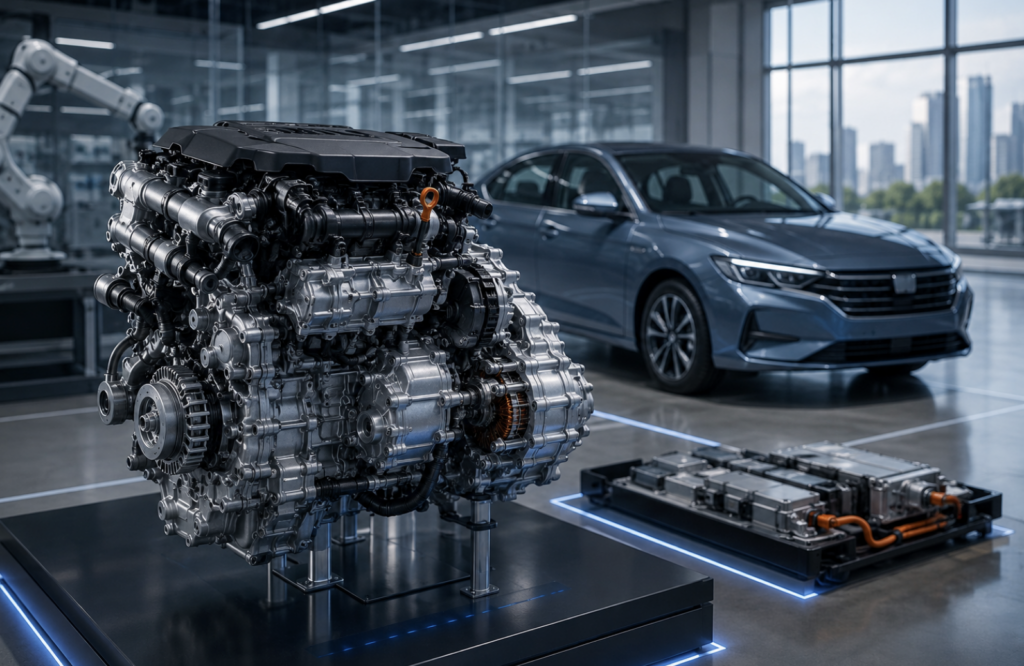
HANGZHOU, China — Geely Auto has introduced a new hybrid powertrain that the company says achieves a peak thermal efficiency of 48.41 percent, a figure independently certified by the China Automotive Technology and Research Center (CATARC) and recognized by Guinness World Records in connection with a fuel-consumption demonstration conducted in China.
The technology, branded i-HEV (Intelligent Hybrid Electric Vehicle), was officially unveiled on April 13, 2026, as part of Geely’s next-generation hybrid strategy. It combines a newly developed dedicated combustion engine with an integrated electric drive system and AI-assisted energy management designed to optimize engine and battery operation under varying driving conditions.
From Engineering Program to Production Vehicle
The first production vehicle to use the system is the fifth-generation Geely Emgrand i-HEV, which made its public debut at the 2026 Beijing Auto Show before entering the Chinese market on June 16, 2026.
According to Geely, the hybrid system achieved a fuel consumption of 2.22 liters per 100 kilometers during a Guinness-certified road test conducted on Hainan Island. While the result reflects a specific test scenario rather than a standardized WLTC or EPA certification cycle, the engine’s 48.41 percent thermal efficiency represents one of the highest figures publicly reported for a mass-produced gasoline engine.
Hybrid Architecture Designed for Broader Deployment
The i-HEV architecture employs a P1+P3 dual-motor configuration together with an integrated 11-in-1 electric drive unit. Geely says the platform has been designed for deployment across several high-volume models. In addition to the Emgrand sedan, the company has confirmed plans to introduce the technology in vehicles including the Geely Preface (Xingrui) and the Geely Monjaro (Xingyue L) as part of a broader expansion of its hybrid portfolio.
The company has indicated that the platform was developed not as a single showcase project, but as a scalable hybrid architecture intended for future mainstream passenger vehicles.
Why Thermal Efficiency Matters
The development reflects a wider trend within the global automotive industry. While many manufacturers continue investing heavily in battery-electric vehicles, demand for hybrid powertrains has remained resilient in several major markets, particularly where charging infrastructure is still developing or where consumers seek longer driving range without relying exclusively on external charging.
Thermal efficiency—the proportion of fuel energy converted into useful mechanical work—is one of the most important measures of an internal combustion engine’s performance. Improvements in this figure reduce fuel consumption and carbon dioxide emissions while allowing manufacturers to continue using existing fuel infrastructure.
Competition Beyond Electrification
In recent years, Chinese, Japanese, European and South Korean automakers have continued refining hybrid systems despite accelerating investment in battery-electric vehicles. The latest generation of hybrid engines demonstrates that conventional combustion technology remains an active area of engineering development rather than a mature technology with little room for improvement.
Industry analysts note that advances in combustion efficiency are increasingly being achieved through the combination of optimized engine design, high-pressure fuel injection, advanced combustion control, electric assistance and software-based energy management rather than through mechanical improvements alone.
Implications for the Global Automotive Industry
For Geely, the new hybrid system represents both a technical achievement and a strategic platform intended for large-scale production. It also highlights the growing role of Chinese manufacturers in powertrain development, an area historically led by Japanese and European automakers.
For the broader automotive industry, the announcement suggests that hybrid technology is likely to remain an important component of global vehicle portfolios for years to come, particularly in markets where charging infrastructure, consumer demand and regulatory requirements continue to favor multiple propulsion technologies.
Whether similar efficiency levels can be consistently achieved under standardized international testing procedures and diverse real-world operating conditions will ultimately determine the long-term significance of Geely’s latest hybrid engine. Nevertheless, its introduction illustrates that innovation in combustion-engine technology continues alongside the industry’s broader transition toward electrification.
Photo: AI