
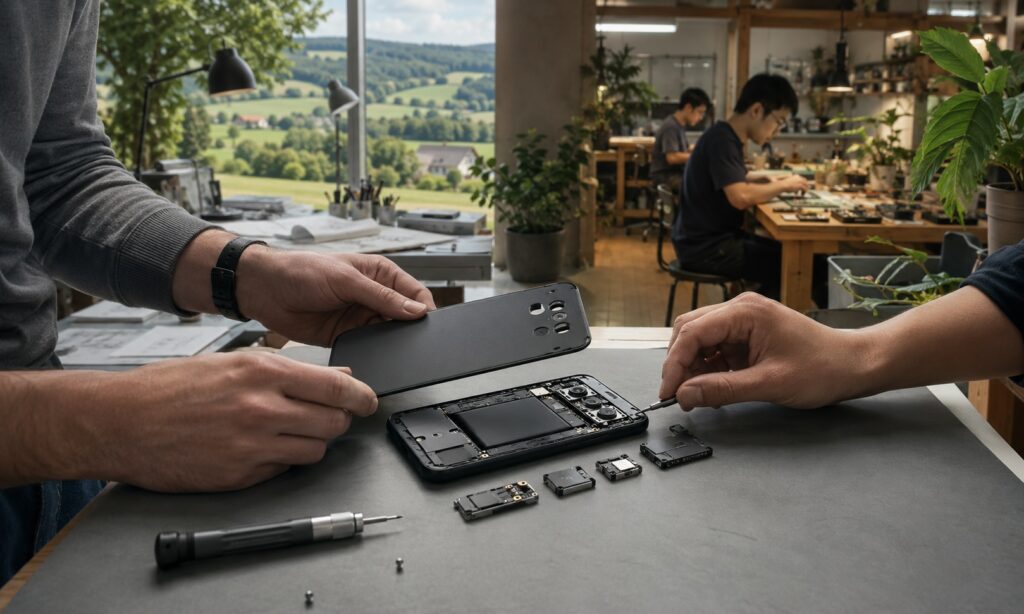
FALKENBERG, Germany — In a rural corner of northern Hesse, far from Europe’s traditional technology centers, a small family-controlled company is attempting something the continent has largely abandoned: building its own smartphone brand.
SHIFT’s latest device, the SHIFTphone 8.1, is conceived and developed in Germany but assembled in China. That distinction makes it neither a conventionally German-made phone nor simply a Chinese handset carrying a European label. Instead, it represents a more complicated experiment in repairability, ethical production and European control over product design.
A German Idea, an Asian Supply Chain
Founded in 2014 by the Waldeck family and financed initially through crowdfunding, SHIFT operates without conventional outside investors. Product design, software adaptation, service and repair operations are based in Falkenberg, near Kassel. The company says profits are retained for social, environmental and business purposes rather than distributed to private investors. Germany’s Handelsblatt has described the company as an unusual attempt to develop sustainable electronics without surrendering control to external capital.
Manufacturing is another matter. Displays, processors, memory, cameras and most other essential components come from Asian suppliers. Early SHIFTphones were assembled by an outside contractor in Shenzhen. In 2018, SHIFT established what it describes as its own dedicated workshop in Hangzhou, allowing the German company greater oversight of final assembly and working conditions.
SHIFT says development remains in Germany while production takes place in China because the essential smartphone supply network no longer exists in Europe. The company states that plainly on its website — an unusual degree of clarity in an industry where European branding can obscure Asian origins.
A 2026 analysis by the German newspaper Die Zeit called SHIFT the country’s answer to Fairphone, while acknowledging that European alternatives for chips, memory and other critical components are effectively unavailable.
Repairability, at a Premium
The SHIFTphone 8.1 costs about €695, plus a refundable €22 device deposit. It has a 6.67-inch 120-hertz AMOLED display, 12 gigabytes of memory, 512 gigabytes of storage, microSD expansion and a Qualcomm QCM6490 processor related to the Snapdragon 778G platform.
Its defining features, however, are not conventional performance specifications. The phone contains 18 replaceable modules, a removable 3,820-milliampere-hour battery and physical switches that disconnect its cameras and microphones. Components are largely screwed or plugged into place rather than permanently glued. Opening or repairing the device does not automatically invalidate its warranty.
It is also certified to IP66, offering substantial protection against dust and powerful water jets — a notable achievement for a modular phone. That combination of water resistance and repairability helped the device win Germany’s 2025 Federal Ecodesign Award.
The trade-off is value for money. An international review by Stuff praised the privacy controls and repairable construction but found the processor, battery and cameras modest for a phone in this price range. The publication concluded that its hardware resembled that of considerably cheaper devices.
Other reviewers have been more positive about its AMOLED display, replaceable battery and unusually accessible internals. The divide reflects the central question surrounding SHIFT: whether a smartphone should be judged primarily by benchmark performance or by how long it can remain useful.
The Risks of Being Small
SHIFT’s limited scale has produced visible difficulties. The original SHIFTphone 8.0 entered production without full 2G support. The problem could not be corrected through software, forcing the company to redesign the mainboard and introduce the SHIFTphone 8.1. Deliveries were also delayed repeatedly during the crowdfunding and preorder period.
By 2026, SHIFT said it had received roughly 10,000 preorders and moved the device into regular distribution. Its public development record documents both the delays and the hardware revision — transparency that may reassure supporters, while also illustrating the risks of buying from a small manufacturer.
Software presents a similar tension. The standard Google-certified ShiftOS version is still based on Android 14, while the Google-free ShiftOS Light has moved to Android 15. SHIFT promises security support into the 2030s and encourages alternative systems including /e/OS, CalyxOS, iodéOS and community-supported ROMs. But a long support promise is not necessarily the same as rapid, predictable updates from a company with limited engineering resources.
A Fairer Factory — but Not a Fully Fair Phone
SHIFT says employees at its Hangzhou workshop work flexible 40-hour weeks, have free weekends and receive wages substantially above the local minimum. Germany’s UN Global Compact Network has presented the facility as a case study in improving working conditions through direct control of final assembly.
Yet final assembly represents only one part of a smartphone’s environmental and human footprint. A company of SHIFT’s size cannot fully supervise the mines, semiconductor plants, display factories and battery-material suppliers further upstream. Its production may be more responsible than the industry norm, but the description of a completely fair smartphone would go beyond the available evidence.
Europe’s Smartphone Dilemma
SHIFT is not producing a wholly German smartphone. Nor does it pretend to. It is producing a German-directed device inside an overwhelmingly Asian industrial system.
For buyers seeking the strongest camera, fastest processor or most polished software experience at around €700, larger manufacturers offer more. For those who value a replaceable battery, physical privacy controls, local repair support and a business model designed around longevity, SHIFT presents a rare alternative.
Its importance may therefore extend beyond its modest sales. SHIFT demonstrates that European companies can still control design, software choices and product philosophy — but also that Europe presently lacks the manufacturing ecosystem required to build an advanced smartphone independently.
The contradiction embodied by SHIFT is ultimately Europe’s own: the desire for technological sovereignty, constrained by decades of dependence on factories and component suppliers elsewhere.
Sources: SHIFT, Handelsblatt, UN Global Compact Network Germany, Federal Ecodesign Award, DIE ZEIT