
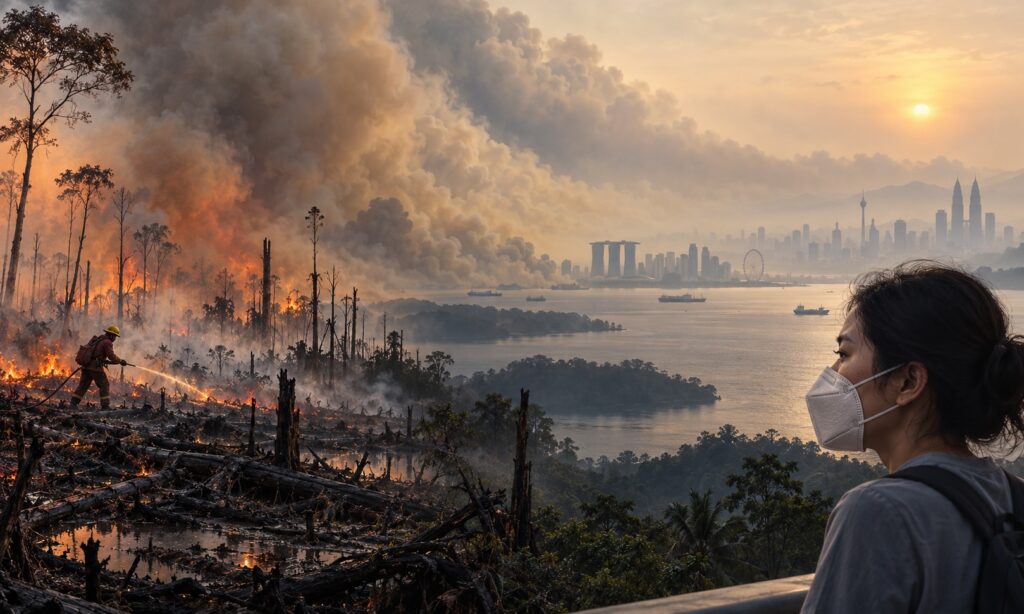
JAKARTA, Indonesia – Smoke from Indonesia’s forest and peatland fires is deepening a regional health emergency, disrupting schools, transport and daily life while increasing pressure on governments to turn diplomatic promises into action. Southern Southeast Asia remains under the ASEAN Specialised Meteorological Centre’s highest haze warning, Level 3, indicating a severe risk of pollution crossing national borders.
The consequences extend well beyond obscured skylines. Indonesian Health Ministry figures cited by Reuters recorded 283,270 cases of respiratory illness linked to the fires across seven provinces through October 13—more than double the September 9 tally. In Singapore, hourly fine-particle pollution reached the official “very high” category on Wednesday; Timor-Leste suspended classroom teaching for three days beginning Thursday.
Jakarta Seeks Relief—and Accepts Help
Indonesia said Saturday that aircraft had dispersed 2.4 tonnes of dry ice over South Sumatra during a two-day operation focused on improving visibility around Palembang’s airport. Officials reported clearer conditions but acknowledged that further research was needed to determine whether the treatment, rather than changing weather, explained the improvement.
The experiment illustrates the limits of emergency measures against a persistent source of smoke. El Niño-related dryness has intensified the fires, while degraded peatlands allow combustion to continue underground. Restoring water levels and preventing land degradation therefore remain central to reducing future outbreaks.
President Prabowo Subianto has approved assistance from neighboring countries, with deployment arrangements under technical discussion, according to Indonesian officials. That opening offers a route toward broader cooperation, although approval alone does not establish how quickly assistance will reach affected areas.
Accountability Moves to the Fore
Singapore’s National Environment Agency said Friday that it had issued preventive notices to seven companies holding Indonesian land concessions, after finding indications that smoke from fires on those lands could have reached Singapore. The notices require firefighting, an end to burning and plans to prevent recurrence. They represent an enforcement step, rather than a final judicial determination of responsibility.
Public frustration is sharpening the diplomatic stakes. “This thing needs to stop,” Zul Hafiz, a Malaysian teacher, told AFP on Saturday. Philippine officials say haze will feature in meetings preceding November’s ASEAN summit in Manila.
The emerging test is whether firefighting assistance and corporate scrutiny can become a sustained regional response. Temporary improvements in visibility offer relief; preventing the next emergency requires action on the land where the smoke begins.