

The facility will become the production home of a next-generation blended-wing aircraft
GREENSBORO, N.C., USA — Aviation startup JetZero has officially launched construction of its first manufacturing and final assembly campus, marking one of the most ambitious aerospace investments in the United States in decades.
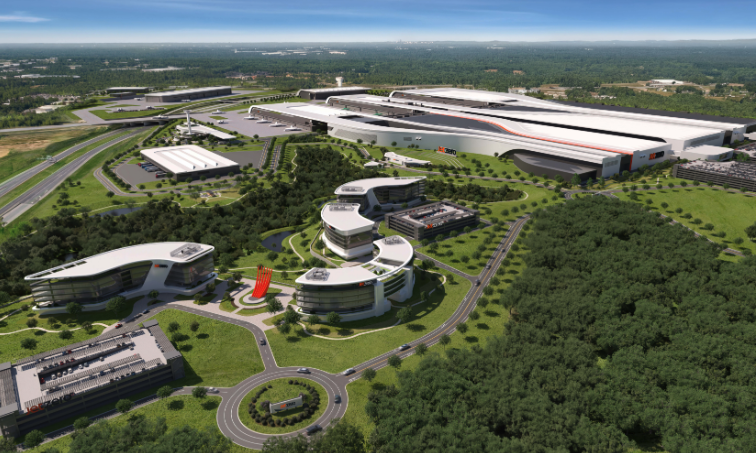
The company broke ground on June 15 on an eight-million-square-foot production facility spanning more than 600 acres in Greensboro, North Carolina. Supported by what state officials describe as the largest incentive package ever awarded to a startup by a U.S. state government, the project is expected to generate approximately 14,500 jobs and attract $4.7 billion in investment over the next ten years.
The facility will become the production home of JetZero’s Z4, a next-generation blended-wing aircraft designed to challenge conventional airliner architecture and dramatically improve fuel efficiency.
A Different Aircraft for a Changing Industry
Unlike traditional tube-and-wing airliners, the Z4 employs an all-wing configuration that integrates the fuselage and wings into a single aerodynamic structure. The aircraft is designed to carry approximately 250 passengers over distances of up to 5,000 nautical miles while using up to 50 percent less fuel than comparable aircraft currently in service.
JetZero argues that the design addresses two of the airline industry’s most pressing challenges: reducing emissions and lowering operating costs. The company also says the aircraft will fit within existing airport infrastructure, avoiding the need for major changes to gates, runways, or ground-handling systems.
Industry analysts note that airlines worldwide are facing increasing pressure to improve sustainability while coping with rising fuel costs and growing demand for long-haul travel. The International Air Transport Association (IATA) projects continued growth in global passenger traffic over the coming decades, placing renewed emphasis on more efficient aircraft technologies.
North Carolina Strengthens Its Aerospace Ambitions
Governor Josh Stein described the investment as a transformative moment for the state’s aerospace sector.
“Today, a great new chapter in North Carolina’s storied history of flight is taking off,” Stein said, highlighting the state’s workforce, research universities, technical colleges, and long-standing aviation heritage.
The project further strengthens North Carolina’s position as an emerging aerospace hub at a time when manufacturers are seeking new production capacity beyond traditional industry centers in Washington State and Kansas.
For Greensboro and the broader Piedmont Triad region, economic development experts compare the project’s potential impact to major industrial investments in electric vehicles, semiconductors, and advanced manufacturing that have reshaped regional economies across the United States in recent years.
Competing Against Industry Giants
JetZero’s ambitions come at a pivotal moment for the global aerospace industry.
Boeing and Airbus continue to dominate commercial aircraft production, while emerging players are exploring alternative designs, sustainable aviation fuels, hybrid-electric propulsion, and advanced composite structures. Yet few projects have attracted as much attention as JetZero’s blended-wing-body concept, which has received support from the U.S. Air Force and NASA research programs.
The company’s leadership believes the timing is right for a departure from conventional aircraft design.
“The time has come for an all-wing airplane,” said Tom O’Leary, JetZero’s CEO and co-founder. “We intend to reshape aviation from right here in North Carolina.”
Industry observers caution that bringing a radically new aircraft to market remains one of the most difficult challenges in manufacturing. Certification requirements, supply-chain development, airline adoption, and production scaling will all be critical tests in the years ahead.
Military Applications Expand Strategic Importance
Beyond commercial aviation, JetZero is developing military variants of the Z4 platform, including aerial refueling and transport aircraft.
Defense analysts note that the blended-wing design offers significant operational advantages, including greater fuel efficiency, increased payload capacity, and extended range. According to the company, a tanker version could provide either twice the range or twice the payload of conventional alternatives, enhancing long-range U.S. military operations.
As global defense planners increasingly focus on Indo-Pacific logistics and extended operational reach, aircraft capable of carrying more fuel and cargo at lower operating costs are attracting growing interest.
Symbolism Beyond the Factory
The groundbreaking arrives just weeks before the United States marks the 250th anniversary of its founding, lending additional symbolism to the event.
Supporters of the project see JetZero as part of a broader resurgence in American advanced manufacturing and aerospace innovation. Whether the company ultimately succeeds in transforming commercial aviation remains uncertain, but the scale of its investment reflects growing confidence that the next major breakthrough in aircraft design may come not from incremental improvements, but from fundamentally reimagining the shape of the airplane itself.
If successful, the Z4 could represent one of the most significant shifts in commercial aviation since the introduction of the jet age.