
ASEAN Summit Highlights Russia’s Search for Partners Beyond the West
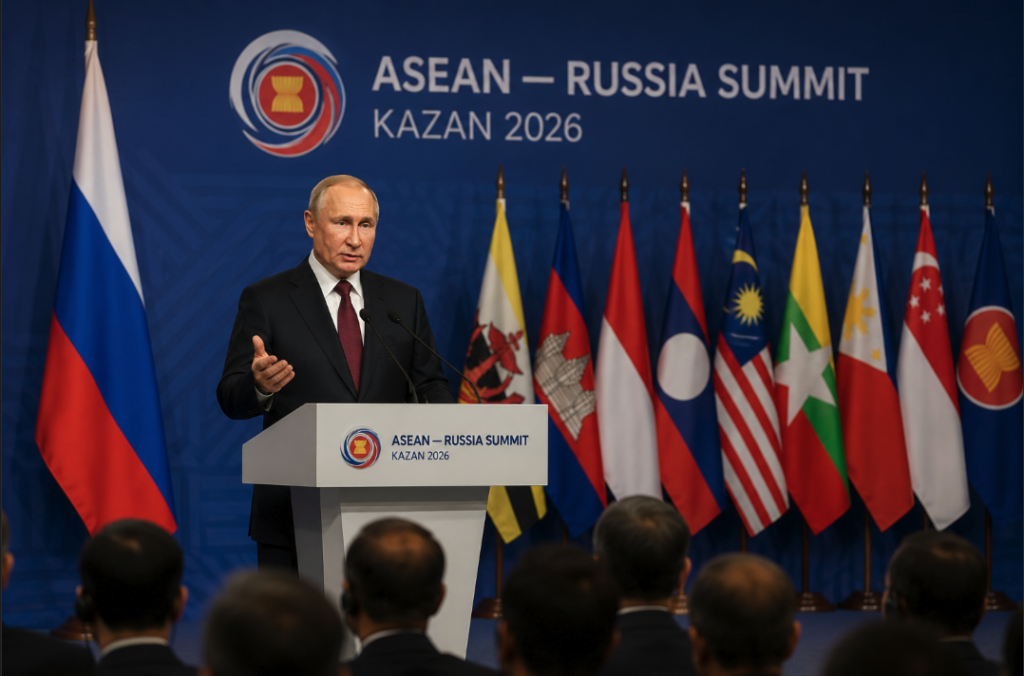
KAZAN, Russia — As Ukrainian drones struck deep into Russia’s energy infrastructure and Western leaders pledged tougher economic measures against Moscow, President Vladimir Putin welcomed Southeast Asian leaders to the Russian city of Kazan this week in a carefully staged display of international engagement.
The ASEAN–Russia Summit, attended by leaders and senior representatives from countries including Vietnam, Thailand, Cambodia, Singapore, Malaysia and Brunei, was designed to showcase Russia’s growing ties with emerging economies and reinforce its role as a strategic partner in Asia. The gathering coincided with the Group of Seven summit in Évian-les-Bains, France, where Western leaders reaffirmed support for Ukraine and agreed to increase pressure on Russia’s wartime economy, particularly its oil and gas sector.
For the Kremlin, the timing was significant. Since Russia’s invasion of Ukraine in 2022, Moscow has sought to deepen relationships with countries outside the Western alliance, presenting itself as a pillar of a more multipolar international order.
Energy Security Takes Center Stage
Energy cooperation emerged as a central theme of the Kazan summit. Russia remains one of the world’s largest exporters of oil, natural gas and nuclear technology, while many Southeast Asian economies face rapidly rising energy demand.
In a joint statement, ASEAN members agreed to expand cooperation in renewable energy, natural gas, liquefied natural gas (LNG), and broader energy-transition initiatives. The agreement reflects growing regional concerns about long-term energy security and supply diversification amid global geopolitical tensions.
Putin told participants that significant opportunities exist in energy and food security, transportation, logistics, advanced technologies and the peaceful use of nuclear energy. Russian officials have increasingly promoted these sectors as foundations for long-term partnerships with developing economies seeking alternatives to traditional Western suppliers.
Ukrainian Drone Campaign Challenges Moscow’s Narrative
Yet the summit unfolded against a backdrop of escalating attacks on Russia’s own energy network.
According to Russian authorities, air-defense systems intercepted roughly 180 Ukrainian drones during overnight attacks. Several drones reportedly reached energy-related targets, including an oil refinery, continuing a campaign that Kyiv has intensified throughout 2026.
The strikes are part of Ukraine’s broader strategy of targeting fuel production, refining capacity and logistics infrastructure that support Russia’s military operations. Similar attacks earlier this summer triggered fires at energy facilities near St. Petersburg during another high-profile international event hosted by the Kremlin.
Although Putin did not mention the attacks during his opening remarks, they underscored an increasingly uncomfortable reality for Moscow: while Russia promotes itself as a guarantor of global energy stability, its own energy infrastructure is becoming more vulnerable to long-range Ukrainian operations.
G7 Seeks to Tighten Economic Pressure
At the same time, leaders meeting in France used the G7 summit to signal continued unity on Ukraine.
In a joint communiqué, the G7 pledged to strengthen sanctions targeting Russia’s war economy, including additional measures affecting oil and gas revenues. Leaders also committed to expanding military and energy support for Ukraine while seeking to reduce global vulnerabilities in critical energy supply chains.
Western policymakers increasingly view Russia’s energy exports as one of the principal financial foundations of the war. Analysts note that declining revenues, growing transportation constraints and sanctions on Russia’s so-called “shadow fleet” have added pressure to the Kremlin’s budget, even as Moscow continues to redirect exports toward Asia.
A Contest Over Global Influence
The near-simultaneous meetings in Kazan and Évian highlighted a widening geopolitical divide.
While the G7 focused on sustaining support for Ukraine and tightening sanctions, Russia sought to demonstrate that it remains an influential actor with partners across Asia, Africa and the Global South. Political analysts describe the contrasting summits as a reflection of an evolving international landscape in which many countries pursue pragmatic engagement with both Western and non-Western powers rather than aligning exclusively with one bloc.
Putin used the gathering to promote themes of sovereign equality and non-interference, principles that resonate with many developing nations wary of great-power rivalry. On the sidelines, he held bilateral meetings with leaders including Brunei’s Sultan Hassanal Bolkiah and Malaysian Prime Minister Anwar Ibrahim, while also consulting with Turkish Foreign Minister Hakan Fidan.
An Uneasy Balance
For ASEAN governments, engagement with Russia reflects practical considerations as much as geopolitical positioning. Southeast Asian nations continue to seek reliable energy supplies, investment opportunities and diversified diplomatic relationships. At the same time, most remain cautious about becoming entangled in broader confrontations between Russia and the West.
The Kazan summit demonstrated that despite years of sanctions and diplomatic isolation efforts, Russia retains avenues for international cooperation. Yet the simultaneous drone strikes and mounting Western pressure also revealed the limits of Moscow’s position.
As Ukraine expands its reach into Russian territory and the G7 prepares a new phase of sanctions, the Kremlin faces the challenge of convincing partners abroad that Russia remains a stable and dependable power—even as the war increasingly reaches its own strategic infrastructure.