
JAKARTA, Indonesia – A powerful earthquake struck the Northern Molucca Sea off eastern Indonesia early Thursday, killing at least one person, damaging buildings in North Sulawesi and North Maluku, and briefly raising fears of a wider tsunami across parts of the western Pacific. Indonesian and international agencies described the quake at between magnitude 7.4 and 7.6, with a depth of about 35 kilometers, and said the tsunami threat was later lifted after monitoring showed only limited wave activity.
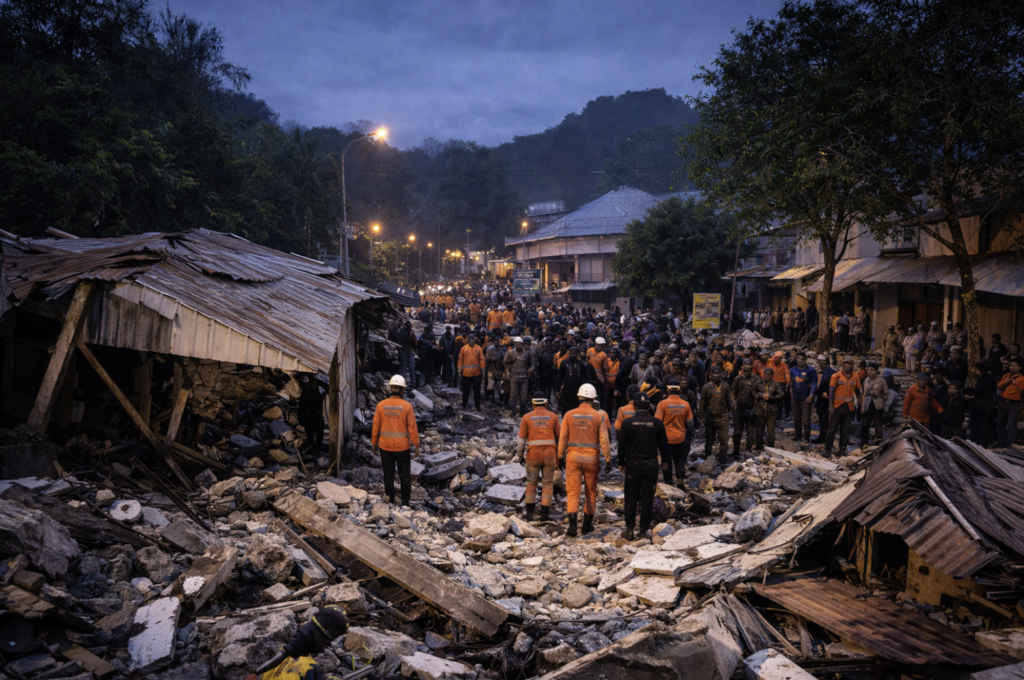
The deadliest confirmed casualty was a 70-year-old woman in Manado, who was killed by falling debris after part of a building collapsed. Indonesian authorities and international wire reports said other injuries were also recorded, including people hurt in panic-driven attempts to flee buildings. Initial damage reports pointed to harm to homes, a church and sports facilities, while fuller assessments continued through the day.
The shaking was felt strongly in Bitung, Ternate and surrounding coastal areas, where residents described one of the most intense tremors in recent memory. Aftershocks followed quickly, with Indonesian officials reporting dozens of them by late morning. BMKG, Indonesia’s meteorology and geophysics agency, said tsunami waves were recorded at several points, including a wave of about 0.75 meters in North Sulawesi, before the warning was canceled.
The international alarm was broad but short-lived. The Pacific Tsunami Warning Center said waves of 0.3 to 1 meter above tide level were possible for some Indonesian coasts, with smaller waves possible for places including Guam, Japan, Malaysia, Papua New Guinea, the Philippines and Taiwan. Japanese authorities said slight sea-level changes were possible but no damage was expected, while Philippine officials said there was no destructive tsunami threat to the country.
Inside Indonesia, the response quickly shifted from warning to stabilization. President Prabowo Subianto ordered rapid emergency measures in affected areas, according to Antara, while BMKG deployed expert teams and urged residents not to re-enter cracked or visibly damaged buildings until inspections were complete. Indonesia’s disaster agency also told the public to remain alert because aftershocks could continue.
The quake struck in one of the world’s most seismically active corridors, where several tectonic plates interact along the Pacific “Ring of Fire.” Reuters, citing U.S. Geological Survey analysis, reported that nine earthquakes of magnitude 7 or greater have occurred within 250 kilometers of the area over the past 50 years. That history helps explain both the severity of the shaking and the relatively fast official response: agencies across the region now routinely issue precautionary alerts even when projected waves are modest, reflecting lessons drawn from past disasters in Indonesia and the wider Indo-Pacific.
Still, the event exposed the familiar imbalance that shapes disaster risk in eastern Indonesia: even when the tsunami danger proves limited, shallow offshore quakes can cause casualties through localized structural failure, panic evacuations and uneven building resilience. The latest assessments suggested the broader economic impact was likely to remain limited, but officials warned that the immediate danger had not fully passed so long as aftershocks continued.