
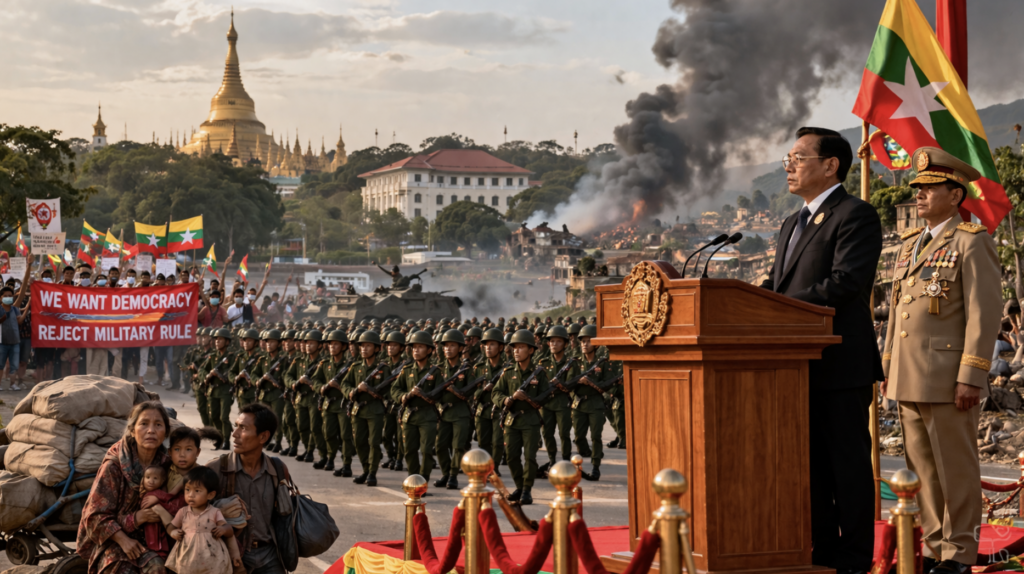
YANGON, Myanmar – Five years after seizing power in a coup that upended a fragile democratic transition, Min Aung Hlaing has formally assumed the presidency of Myanmar, completing what the military describes as a return to civilian governance.
Yet analysts, opposition figures and international observers widely characterize the transition as nominal, arguing that the military’s grip on power remains effectively unchanged.
A Transition in Name Only
The newly convened parliament, meeting for the first time since the 2021 coup, selected Min Aung Hlaing as president after an election critics say was tightly controlled. The military-backed Union Solidarity and Development Party secured a dominant share of contested seats, while the armed forces retained a constitutionally guaranteed bloc of parliamentary representation.
Although Min Aung Hlaing formally stepped down as commander-in-chief, he has installed a trusted ally, General Ye Win Oo, in his place and established a powerful consultative council overseeing both civilian and military affairs.
Regional analysts say these moves ensure continuity rather than change. “This is a restructuring of authority, not a transfer of it,” said a Southeast Asia political specialist based in Singapore.
War, Displacement and Economic Collapse
The political transition unfolds against a backdrop of deepening crisis. Since the coup that removed Aung San Suu Kyi and her elected government, Myanmar has descended into a widespread civil conflict.
According to data from Armed Conflict Location & Event Data Project, resistance forces continue to control significant territory, including dozens of towns across multiple regions. Military operations — including air and drone strikes — have intensified in contested المناطق, often targeting infrastructure such as schools and clinics.
Humanitarian conditions have deteriorated sharply. The United Nations estimates that more than 16 million people now require urgent assistance, with nearly four million displaced. Inflation has surged, and basic services have collapsed in many areas.
Resistance Holds Ground, Conflict Persists
Opposition to military rule remains fragmented but resilient. The shadow administration known as the National Unity Government continues to reject the election and the new government as illegitimate, pledging to pursue a federal democratic system.
Despite internal divisions among armed resistance groups, they retain control of key المناطق, complicating the military’s efforts to consolidate authority. Analysts warn that the appointment of hardline leadership within the armed forces signals a continuation — and possible escalation — of current tactics.
“The conflict will remain largely unchanged,” said Su Mon, a senior analyst at ACLED, noting that military strategy is likely to focus on reclaiming territory through intensified offensives.
International Reactions and Strategic Concerns
Since early April 2026, international responses have remained cautious but critical. Western governments have reiterated calls for inclusive dialogue and humanitarian access, while maintaining targeted sanctions against military-linked entities.
Regional actors, including members of the Association of Southeast Asian Nations (ASEAN), have expressed concern over escalating violence but remain divided on engagement strategies. China and Russia continue to maintain diplomatic and economic ties with Myanmar’s leadership, emphasizing stability and non-interference.
Recent geopolitical developments — including disruptions linked to conflict in the Middle East — have further strained Myanmar’s fragile economy. Fuel shortages have worsened, with imports restricted and prices rising sharply, placing additional pressure on businesses and households already coping with unreliable electricity supply.
No Signs of Reconciliation
In a recent Armed Forces Day address in Nay Pyi Taw, Min Aung Hlaing dismissed opposition groups as “terrorist factions” supported by foreign actors, offering no indication of political compromise.
For many observers, the speech underscored the continuity of military rule despite the formal transition to a civilian presidency.
“The structure has changed,” said one Yangon-based economist, “but the system — and its consequences for ordinary people — has not.”
As Myanmar enters this new political phase, the prospects for peace, stability and democratic reform remain uncertain, with the country’s trajectory still defined by conflict, economic hardship and contested legitimacy.