
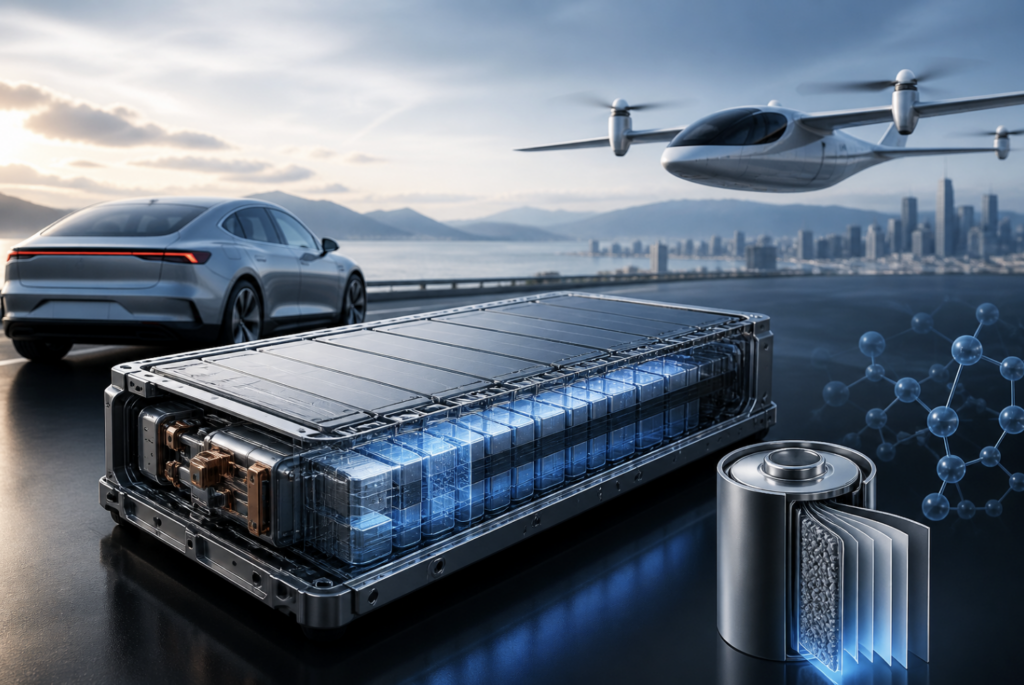
NINGDE, China – The global race to extend the limits of electric mobility may be entering a new phase. China’s Contemporary Amperex Technology Co. Limited (CATL), the world’s largest electric vehicle battery manufacturer, has unveiled what it calls a “condensed battery,” a next-generation power system that it claims could deliver driving ranges of up to 1,500 kilometers (930 miles) on a single charge.
The announcement has stirred optimism across the automotive and aviation industries — and skepticism among analysts who question how quickly such promises can translate into mass adoption.
At the core of CATL’s innovation is a semi-solid, or “condensed,” cell architecture. Unlike conventional lithium-ion batteries that rely heavily on liquid electrolytes, this design incorporates a semi-solid structure that significantly enhances energy density while improving safety.
The company reports energy densities reaching up to 500 Wh/kg at the cell level and 350 Wh/kg at the pack level — figures that, if realized at scale, would represent a substantial leap beyond today’s commercial EV batteries, which typically range between 150 and 250 Wh/kg.
CATL argues that the reduced reliance on flammable liquid electrolytes could nearly eliminate fire risks, a critical concern in both electric vehicles and emerging electric aviation applications. The company has also emphasized the role of advanced materials, including titanium alloy casings, which enhance structural integrity while reducing overall battery weight. In addition, its proprietary electrolyte chemistry is designed to maintain efficient ion transport even under extreme temperature conditions.
A Step Beyond Lithium-Ion — or an Incremental Advance?
Industry experts broadly agree that increasing energy density is essential for unlocking longer-range electric vehicles and enabling electric flight. However, many caution that laboratory performance does not always translate into commercial viability.
Recent analyses from international research groups, including the International Energy Agency (IEA) and BloombergNEF, suggest that while semi-solid and solid-state battery technologies hold promise, they face persistent challenges in manufacturing complexity, cost, and long-term durability. Scaling production while maintaining safety and consistency remains one of the largest hurdles.
Domestic Chinese analysts have been more optimistic, noting CATL’s track record in rapidly industrializing battery innovations. Some point to the company’s aggressive investments in research and vertically integrated supply chains as factors that could accelerate commercialization compared with Western competitors.
Still, global automakers remain cautious. Many are continuing to invest in incremental improvements to conventional lithium iron phosphate (LFP) and nickel-based batteries, which are already cost-effective and proven at scale. Fully transitioning to new chemistries would require retooling factories, requalifying supply chains, and meeting stringent safety certifications — especially in aviation, where regulatory approval can take years.
Implications for Aviation and Long-Range Mobility
Perhaps the most ambitious aspect of CATL’s announcement is its potential application in aviation. High energy density combined with improved safety could make electric aircraft more viable, particularly for short- to medium-haul routes. Industry observers note that reaching thresholds above 400 Wh/kg is often cited as a key requirement for practical electric flight.
Yet aviation experts stress that certification standards, redundancy requirements, and extreme reliability demands make the sector far more conservative than automotive markets. Even if the technology proves viable, widespread adoption in aircraft could take a decade or more.
Balancing Promise with Practicality
The unveiling of the condensed battery underscores a broader trend: the electrification industry is moving from incremental gains toward transformative ambitions. But as with many breakthroughs in battery science, the gap between prototype and production remains significant.
For now, CATL’s announcement serves as both a signal of technological progress and a reminder of the complexities ahead. If the company can deliver on even part of its claims at scale, it could redefine expectations for electric vehicles and beyond. Until then, the condensed battery stands as a compelling — but still unproven — glimpse into the future of energy storage.