
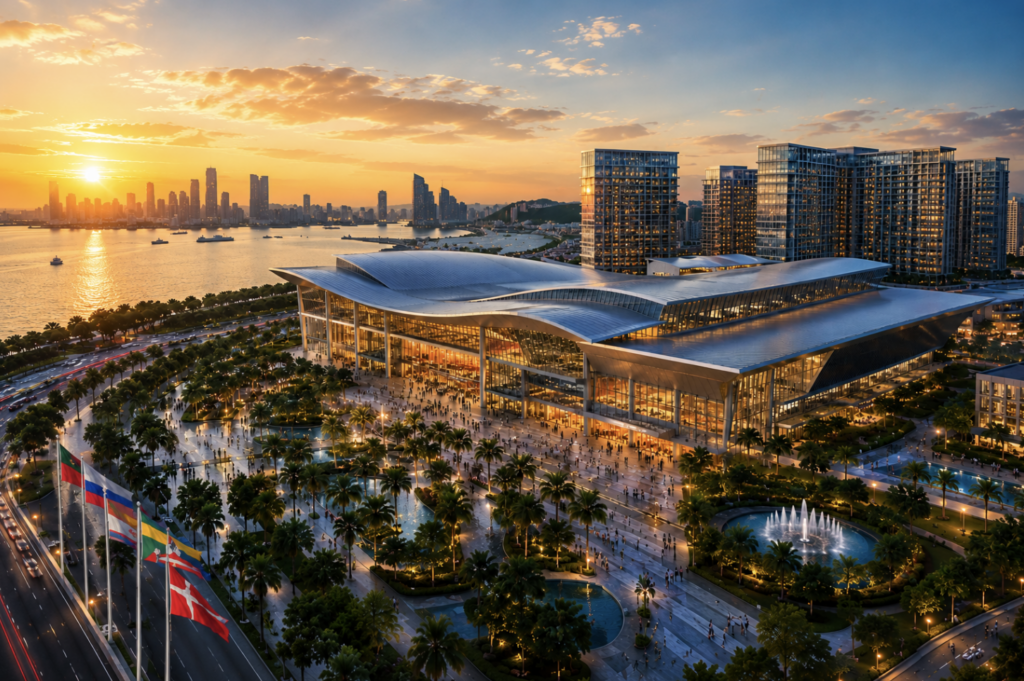
BANGKOK, Thailand – Southeast Asia is rapidly positioning itself as one of the world’s most competitive regions for meetings, incentives, conferences and exhibitions, as governments and private developers pour investment into convention centers, exhibition halls and resort-linked business districts.
The push is most visible in Indonesia, Thailand, Malaysia and Vietnam, where new venues, upgraded convention centers and national MICE promotion campaigns are being marketed to international organizers looking beyond traditional hubs in Europe and parts of the Middle East. The shift is being driven by cost pressures, geopolitical uncertainty, air-connectivity growth and rising demand for destinations that combine business events with leisure, hospitality and large-scale entertainment.
Thailand has moved aggressively to strengthen Bangkok’s role as a regional events capital. The Queen Sirikit National Convention Center has received ASEAN, national and sustainable-event certifications, while also introducing real-time carbon-footprint tracking for MICE events — a sign of how sustainability is becoming a core sales tool rather than a marketing add-on.
Malaysia is also sharpening its business-events strategy. MITEC is being promoted as one of the region’s largest MICE venues, while Malaysia Business Events Week 2025 at MITEC was framed as a platform for the country and region to “connect, create and lead” the next wave of business-event growth.
Vietnam is building momentum around a different proposition: heritage, technology and affordability. Vietnam MICE Expo 2025, held at the National Convention Center in Hanoi, brought together domestic and international buyers and sellers under the theme of heritage and technology, as the country seeks to establish itself as a distinctive Asian MICE destination.
Indonesia, meanwhile, is leaning on scale. ICE BSD is described as Indonesia’s largest convention and exhibition center, spanning 220,000 square meters, with 10 exhibition halls, a convention hall, meeting rooms and outdoor event space. The country’s 2025 events calendar also included international, national and MICE events supported through the Ministry of Tourism’s Event by Indonesia platform.
A regional race for integrated convention ecosystems
The strongest growth is no longer about stand-alone convention halls. Organizers increasingly want integrated resort-and-convention ecosystems: hotels, retail, entertainment, dining, transport access and flexible meeting space in one district. This gives Southeast Asian destinations an advantage because many new projects are being built around mixed-use tourism and hospitality clusters rather than legacy downtown venues.
Industry data supports the optimism. UFI, the global exhibition industry association, projected global exhibition revenues to grow 18 percent year on year in 2025, while ICCA’s latest analytics point to a more competitive global association-meetings market, with Asia-Pacific cities continuing to challenge established Western destinations.
The new selection criteria: hybrid-ready and certified green
Hybrid-event infrastructure has become essential, not optional. Market analysis shows hybrid events are among the fastest-growing segments in Asia-Pacific MICE, while industry conferences in Singapore and across the region have highlighted AI, hybrid business travel, digital transformation and sustainability as defining themes.
Sustainability is moving just as quickly. Venues that can document energy use, waste reduction, carbon tracking and recognized certification are better positioned to win international bids, especially from associations and corporations under ESG pressure.
Summary finding
Southeast Asia’s convention boom is not merely a real-estate story. It is a strategic bid to capture a larger share of global business events at a moment when organizers are reassessing cost, risk, experience and environmental performance. Indonesia offers scale, Thailand offers mature infrastructure, Malaysia offers regional connectivity and institutional promotion, and Vietnam offers fast-rising appeal built around culture, technology and value. Together, they are turning Southeast Asia into one of the most closely watched MICE battlegrounds of the next decade.