
Malaysia’s largest anti-scam crackdown exposes growing regional tensions between tourism openness and transnational crime enforcement
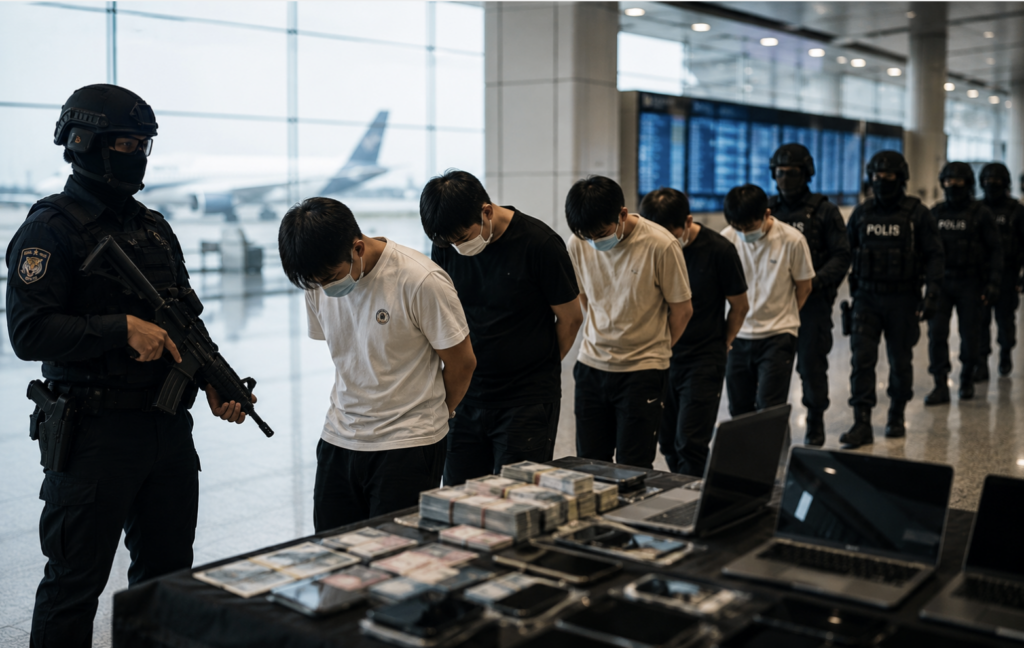
KUALA LUMPUR, Malaysia — Malaysia’s sweeping crackdown on international scam syndicates has intensified scrutiny of Southeast Asia’s increasingly liberal visa policies, after police arrested 187 suspects from nine countries and seized nearly RM58 million (US$14.7 million) in assets during coordinated raids across the Klang Valley earlier this month.
Malaysia’s Inspector-General of Police, Mohd Khalid Ismail, warned that the country’s visa-exemption framework had inadvertently created opportunities for organized criminal groups to establish sophisticated fraud operations under the guise of tourism and short-term visits.
Speaking at the Royal Malaysia Police headquarters on May 15, Mr. Mohd Khalid said authorities were now investigating how foreign suspects entered the country, including whether syndicate members abused social visit passes and other legal entry mechanisms. Initial findings showed that all detained foreign nationals possessed valid travel documentation, underscoring the challenge facing immigration authorities across the region.
The operation, conducted on May 6 and 7, uncovered what investigators described as a deeply interconnected transnational cybercrime ecosystem spanning East and Southeast Asia. Among those arrested were 127 Chinese nationals, 23 Malaysians, nine Japanese citizens, eight Vietnamese nationals and seven Indonesians, alongside suspects from Laos, Thailand, the Philippines and Myanmar. The suspects included 151 men and 36 women.
Police said the syndicates operated investment scams, romance fraud schemes, online gambling networks and impersonation scams targeting victims primarily in Hong Kong, mainland China, South Korea and Japan. Some suspects allegedly posed as Japanese police officers using encrypted and internet-based communication platforms including Telegram, Line and Bria Mobile.
Authorities also confiscated three luxury properties valued at RM38 million, 20 luxury vehicles worth RM6.58 million, luxury goods estimated at RM12 million and more than 550 digital devices believed to have been used in the operations.
Regional Alarm Over Visa-Free Loopholes
Malaysia’s crackdown came just days after Indonesian immigration officials announced a review of Jakarta’s own visa-free entry program following the arrest of more than 500 foreigners linked to illegal online gambling and cyberfraud operations.
Indonesia’s immigration director-general, Hendarsam Marantoko, told AFP that the rise in crimes involving foreign nationals from visa-exempt countries had triggered renewed debate over whether Southeast Asia’s open-border ambitions were outpacing regional enforcement capabilities.
The arrests in Indonesia included nationals from Vietnam, Cambodia, Malaysia, Laos and Myanmar — all countries whose citizens currently enjoy 30-day visa-free entry under ASEAN arrangements — as well as Chinese nationals, despite China not being part of Indonesia’s visa waiver system.
Security analysts across the region say the parallel crackdowns reflect a broader transformation in Southeast Asia’s cybercrime landscape. Over the past three years, organized scam compounds operating in parts of Myanmar, Cambodia and Laos have evolved into multinational criminal enterprises generating billions of dollars annually through online fraud, cryptocurrency laundering, illegal gambling and human trafficking.
According to recent United Nations and regional law-enforcement assessments, many syndicates increasingly rely on legally entered foreign operatives, digital infrastructure spread across multiple jurisdictions and complex financial networks that exploit uneven regulatory enforcement between ASEAN states.
China-Malaysia Visa Deal Faces New Scrutiny
The controversy has also drawn attention to Malaysia’s expanding visa liberalization policies, particularly its strengthened travel agreement with China.
Last year, during Chinese President Xi Jinping’s state visit to Malaysia, both countries agreed to extend mutual visa-free travel arrangements for another five years. Under the deal, Chinese tourists can remain in Malaysia for up to 90 days without a visa, with Malaysian travelers receiving reciprocal treatment in China.
Malaysian Home Affairs Minister Saifuddin Nasution Ismail defended the policy at the time as essential for tourism recovery, business connectivity and bilateral economic growth following the pandemic-era slowdown in regional travel.
Tourism officials and business groups continue to support relaxed entry rules, arguing that Southeast Asia’s economic recovery depends heavily on restoring cross-border mobility, particularly from China, Japan and neighboring ASEAN markets. Malaysia has seen a sharp rebound in international arrivals over the past two years, driven largely by regional tourism and business travel.
Yet cybersecurity experts warn that criminal organizations have adapted quickly to the return of mass mobility in Asia, using legal travel routes, short-term rentals and encrypted digital platforms to establish mobile scam centers that are harder for authorities to detect.
Balancing Tourism Growth With Security Risks
The latest arrests highlight the growing dilemma confronting Southeast Asian governments: how to preserve the economic benefits of open regional travel while containing increasingly sophisticated transnational cybercrime operations.
Analysts say governments are unlikely to abandon visa-free frameworks altogether, given ASEAN’s longstanding commitment to regional integration and tourism-led growth. Instead, authorities are expected to tighten biometric screening, enhance intelligence-sharing and expand joint enforcement operations targeting organized digital fraud networks.
Malaysian police said investigations are continuing to identify the syndicates’ financiers, operational leaders and international criminal connections.
“Investigations are ongoing to identify the masterminds, financial structures and international criminal links behind these syndicates,” Mr. Mohd Khalid said, signaling that authorities believe the raids exposed only part of a much larger regional network.