
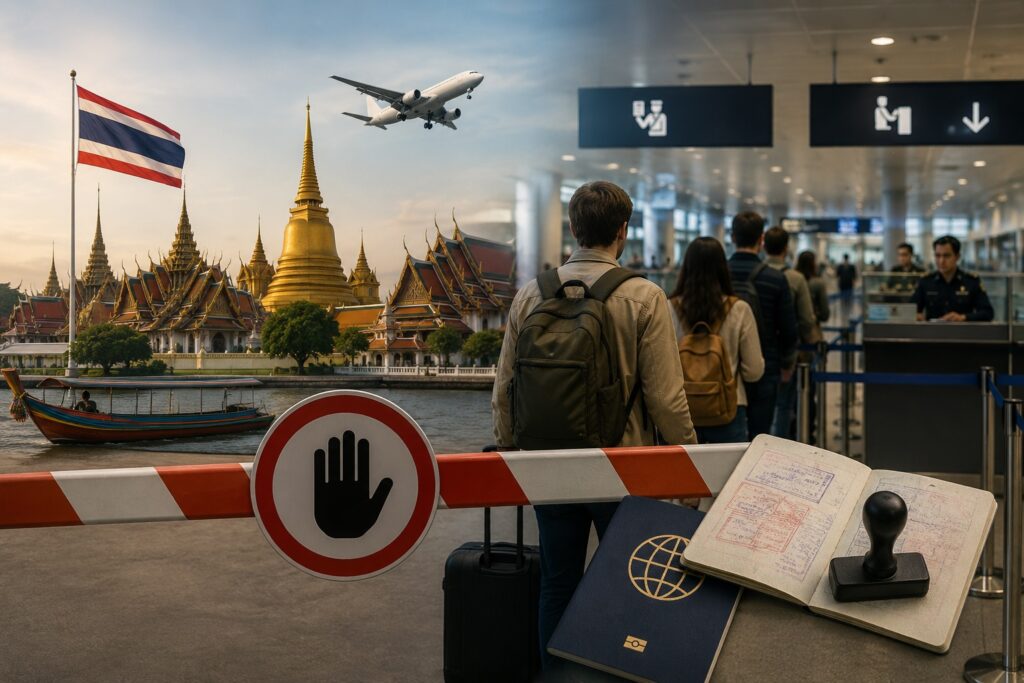
Bangkok Signals a More Cautious Tourism Strategy After Post-Pandemic Surge
BANGKOK, Thailand – Thailand has announced plans to shorten its visa-free stay period for travelers from more than 90 countries, marking a significant shift in one of Asia’s most aggressive post-pandemic tourism recovery policies. The decision reflects a growing tension between Thailand’s dependence on international tourism and rising domestic concerns over security, illegal employment, and transnational crime.
Under the current framework introduced in July 2024, citizens from 93 countries — including the United States, China, Germany, France, Australia, India, Italy, and Spain — could enter Thailand without a visa for up to 60 days. The measure was widely praised by airlines, hotel groups, and tourism operators as Bangkok sought to restore visitor numbers to pre-Covid levels.
But Thai authorities now say the system has become overly complicated and increasingly vulnerable to abuse.
Prime Minister Anutin Charnvirakul said the government concluded the policy must be revised “to be more suitable for the current situation, both in terms of the economy and national security.” The new framework will reduce many visa-free stays to 30 days, though final rules will vary by nationality under reciprocal agreements with individual countries.
The changes are expected to take effect 15 days after publication in Thailand’s Royal Gazette.
Security Incidents and Illegal Employment Intensify Political Pressure
The policy reversal comes amid mounting public scrutiny over foreign criminal activity in Thailand, particularly in Bangkok, Phuket, Pattaya, and Chiang Mai, where authorities have intensified crackdowns on illegal businesses and unlicensed employment networks.
Recent police operations have targeted foreign nationals allegedly linked to drug trafficking, online scam syndicates, illegal schools, sex trafficking, and unauthorized work arrangements. In one widely publicized raid earlier this year, Thai police arrested several foreign employees at an unlicensed international school operating in Bangkok without proper permits.
Thai security agencies have increasingly argued that long visa-free periods allowed some visitors to blur the line between tourism and semi-permanent residency. Immigration officials have also complained that overlapping exemptions, education visas, retirement schemes, and digital-nomad programs created confusion that complicated enforcement efforts.
Domestic commentators in Thailand have broadly supported tighter controls, particularly following concerns that rapid tourism liberalisation outpaced regulatory oversight. Thai business groups, however, remain divided. While hotel operators and airlines fear additional bureaucracy could discourage long-haul travelers, some economists argue the country is moving toward a “quality tourism” model focused on higher spending and longer-term sustainability rather than pure arrival numbers.
A Delicate Moment for Thailand’s Tourism Economy
Tourism remains one of the pillars of Thailand’s economy, contributing a substantial share of employment and foreign exchange earnings. Before the pandemic, Thailand welcomed nearly 40 million international visitors annually, ranking among the world’s most visited destinations.
The collapse of global travel during Covid-19 devastated the sector, forcing Bangkok to adopt increasingly liberal entry measures once borders reopened. The 60-day visa exemption was part of that broader recovery effort, particularly aimed at stimulating arrivals from China, Europe, and other key long-haul markets.
The recovery has been significant but uneven. Thai officials say nearly 12 million international visitors have already entered the country this year, with strong rebounds from regional Asian markets and Europe. Chinese arrivals, however, have remained below pre-pandemic peaks, partly due to economic pressures inside China and safety concerns following high-profile incidents involving Chinese tourists in Southeast Asia.
International tourism analysts say Thailand’s new visa policy reflects a broader regional recalibration. Across Asia, governments are attempting to balance open-border economic strategies with heightened scrutiny over immigration compliance, organized crime, and informal labor markets.
Countries such as Indonesia, Malaysia, and Vietnam have simultaneously expanded selective visa incentives for high-value travelers — including remote workers, investors, and retirees — while tightening enforcement against illegal long-term stays and visa misuse.
International Reaction Likely to Be Mixed
For many Western and Asian travelers, the practical impact may initially appear limited, since short holidays under 30 days remain unaffected. Yet industry analysts warn the changes could affect digital nomads, long-stay retirees, winter travelers, and remote workers who increasingly viewed Thailand as a semi-permanent base.
European travel agencies and airline groups have urged Bangkok to maintain clarity and consistency in implementation, warning that frequent rule changes since the pandemic have created uncertainty for travelers and tourism operators alike.
Thai authorities insist the revised system will ultimately simplify entry rules and strengthen confidence in the country’s immigration framework. But the move also signals a subtle change in tone: after years of prioritizing rapid tourism recovery at almost any cost, Thailand now appears increasingly willing to trade some visitor convenience for tighter control and greater oversight.
For a country whose modern economy has long depended on openness to the world, the challenge ahead may be finding a balance between hospitality and security — without undermining the tourism engine that helped define modern Thailand.