
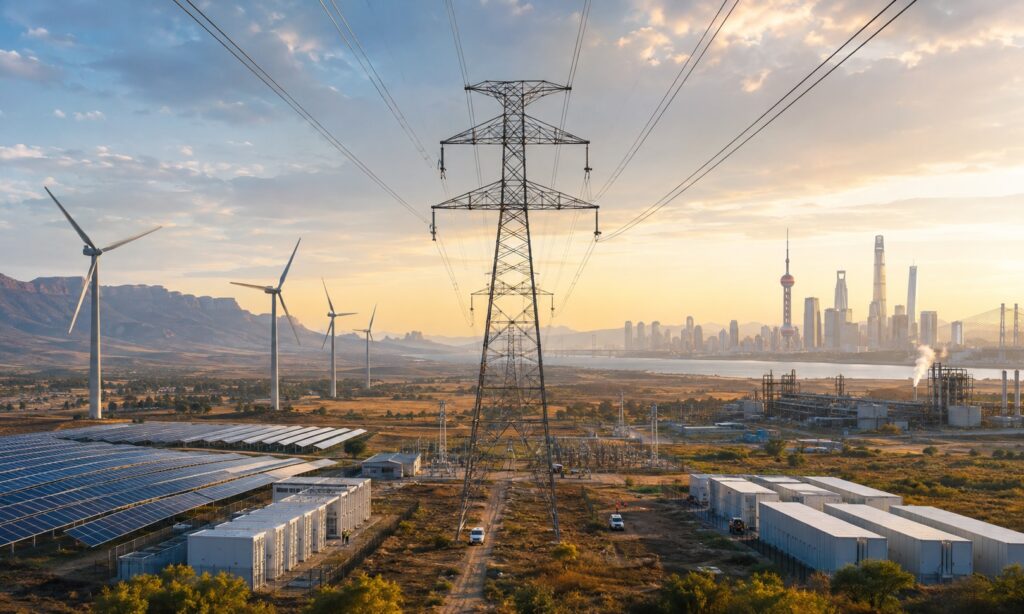
BEIJING, China – South Africa has presented China with one of the developing world’s largest energy-investment programs: more than R2.2 trillion in proposed generation, transmission, storage and manufacturing projects through 2039.
The pitch was at the center of the South Africa-China Electricity and Energy Investment Conference, held Aug. 3 and 4 at POWERCHINA’s headquarters in Beijing. More than 260 government, finance and industry representatives attended, according to the company.
Under South Africa’s Integrated Resource Plan 2025, the country intends to procure approximately 105 gigawatts of new capacity by 2039, drawing on solar, wind, batteries, natural gas and nuclear power. It also plans about 14,500 kilometers of transmission infrastructure, requiring an estimated R440 billion over the next decade.
The scale is striking. The proposed new capacity is more than twice the current generating capacity of Eskom, the state utility. Yet the conference was principally an investment roadshow—not a completed financing agreement.
Interest, but No Blank Check
South Africa’s government said the mission generated preliminary interest from six major energy-equipment manufacturers. It also produced more concrete, if narrower, developments: Envision was commissioned to design a green-hydrogen system for Sasol’s operations, while South Africa’s radioactive-waste institute signed a cooperation agreement with China National Nuclear Corporation.
No comprehensive Chinese commitment to finance the R2.2 trillion program has been publicly announced. The important next test will be whether expressions of interest become projects with defined equity, debt, procurement and risk-sharing structures.
POWERCHINA said it was prepared to help move projects from planning into construction, while emphasizing local sourcing, training and supply-chain cooperation. The company reports that its completed and continuing South African wind, photovoltaic and concentrated-solar projects total 1.9 gigawatts, with another 1.9 gigawatt-hours of battery storage under construction.
Its portfolio includes the 100-megawatt Redstone solar-thermal plant, the Oya wind-solar-battery development and the Mokolo-Crocodile water project, which is intended to support power stations, mines, industries and communities in the Waterberg region.
The Real Constraint Is the Grid
South Africa’s difficulty is no longer simply finding developers willing to build wind and solar plants. It is finding enough transmission capacity to connect them.
The country’s seventh renewable-energy procurement round originally allocated 3.2 gigawatts to onshore wind, but initially selected no wind projects, illustrating how grid congestion can strand otherwise viable generation. Internationally, the same problem is becoming common: the International Energy Agency describes electricity networks as an increasingly serious bottleneck for connecting new generation, storage and demand.
Pretoria has begun opening transmission development to private capital. Seven international consortia have qualified for the first phase of its independent transmission program—including groups led by China’s State Grid and China Southern Power Grid. Detailed bidding is expected after the government issues its request for proposals.
That competition may prove more consequential than the Beijing conference itself. Transmission contracts will reveal the price of capital, the strength of government guarantees and the extent to which foreign contractors must use South African workers and suppliers.
Cheap Technology, Difficult Industrial Choices
China offers South Africa an unusually powerful combination of engineering capacity, large-scale manufacturing and comparatively inexpensive solar, wind and battery equipment. South African energy specialists have welcomed cooperation in grid modernization, storage and local manufacturing, describing China as a central partner in implementing the IRP.
But inexpensive imports also create a policy dilemma. African governments want rapid electrification while seeking to avoid permanent dependence on imported panels, cells, inverters and other high-value components. Much of the continent’s current manufacturing remains concentrated in final assembly rather than core technology.
South Africa is therefore asking Chinese companies to establish factories and supplier networks—not merely sell equipment. Whether procurement contracts enforce those ambitions will determine if the program produces lasting industrial capacity or primarily expands China’s export market.
From Power Crisis to Investment Test
Eskom’s operational performance has improved from the worst years of rolling blackouts, but corporate South Africa continues to seek alternatives. Mining companies are expanding private renewable-power contracts because wind and solar can cost 20 to 30 percent less than projected Eskom tariffs. At the same time, industry executives acknowledge that Eskom and dispatchable generation will remain essential while storage and grid capacity develop.
The Beijing conference has given South Africa access to companies capable of building at exceptional speed and scale. It has not yet solved the harder questions: who will bear the financial risk, how quickly transmission can be delivered, and how much of the resulting industrial value will remain in South Africa.
For Pretoria, success will not be measured by the size of the announced investment opportunity. It will be measured in financed power lines, functioning storage systems, reliable electricity—and factories that continue operating after the delegations have gone home.
Sources: AP, Reuters, South African government