
BERLIN, German/JAKARTA, Indonesia — A German energy-infrastructure company, a major Chinese transformer manufacturer and an Indonesian business partner have formed an alliance around one of the world’s most ambitious—and operationally difficult—solar programs.
ELTEC Green Energy of Germany, TBEA Hengyang Transformer Co. of China and PT Bumi Raya Abadi of Indonesia signed a memorandum of understanding on Aug. 26, creating a framework to pursue projects under President Prabowo Subianto’s plan to build 100 gigawatts of solar capacity by 2029.
The agreement was signed by Björn Heidrich, ELTEC’s managing director, and Sun Hecheng, a vice president of TBEA Hengyang. It covers high-voltage transformers, substations, photovoltaic inverters, battery energy-storage systems, engineering and construction, as well as power infrastructure for industrial estates and data centres. ELTEC’s announcement disclosed no project awards, financial terms or binding investment commitments.
That distinction matters. The MoU gives the companies a platform from which to qualify for tenders, develop technical proposals and assemble project-specific consortiums. It is not, by itself, an order for equipment or a construction contract.
A Partnership Built Around the Grid
The alliance was announced one day after Mr. Prabowo formally inaugurated and broke ground on 14 solar projects with a combined capacity of about 5.3 gigawatts. Two are already operating, six are under construction and six are expected to be offered to investors. The initial projects require an estimated 135 trillion rupiah, or about $7.6 billion, while the full programme could require roughly 1.14 quadrillion rupiah. Reuters reported that the government also intends to replace 13 gigawatts of diesel generation.
The broader plan envisages approximately 80 gigawatts of distributed solar installations serving as many as 80,000 villages, supported by as much as 320 gigawatt-hours of battery storage. A further 20 gigawatts would come from larger, centralized solar plants.
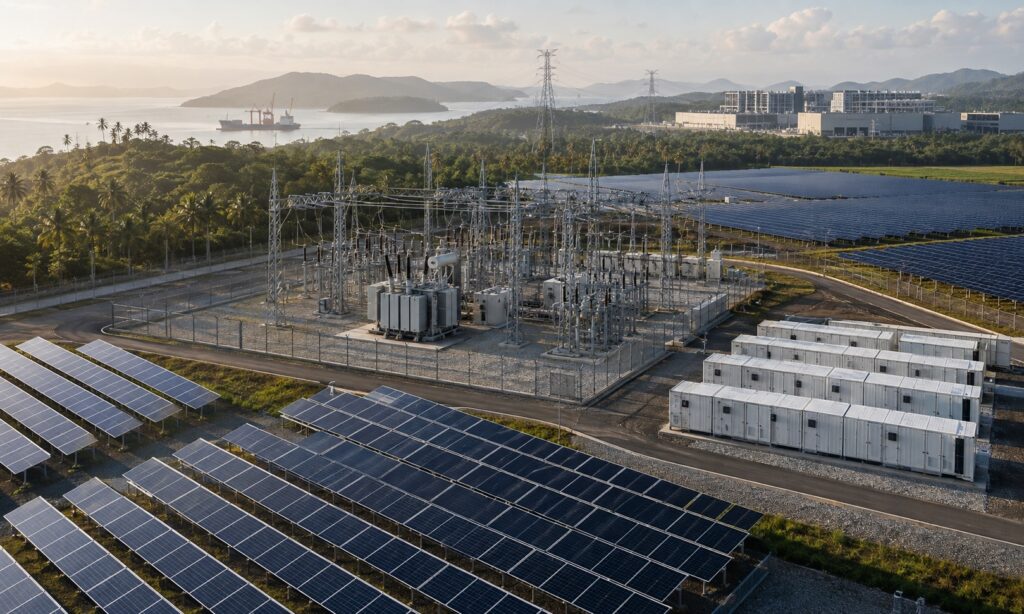
That architecture helps explain the scope of the MoU. Solar panels may be the most visible component, but Indonesia will also need transformers to raise and distribute voltage, inverters to convert and control electricity, batteries to supply power after sunset, and substations and protection systems capable of connecting thousands of projects without destabilizing local grids.
The three companies are effectively proposing an integrated delivery chain: Chinese manufacturing, German-led engineering and international coordination, and Indonesian permitting, stakeholder engagement and field execution.
Three Companies, Three Distinct Roles
ELTEC Green Energy, based in Berlin, supplies transformers, high-voltage cables, switchgear, inverters and battery-storage equipment for utilities, grid operators and renewable-energy developers. The company presents itself as a project integrator—translating local grid requirements into equipment specifications, managing technical compliance and coordinating complex cross-border deliveries. It is also a licensed distributor of TBEA Hengyang products. ELTEC’s corporate profile says its existing focus includes Germany, Britain, Poland and the Benelux markets.
TBEA Hengyang Transformer Co. is a subsidiary of China’s TBEA group and provides research, manufacturing and integrated services for transformers and reactors ranging from distribution voltage to ultra-high-voltage systems. Its manufacturing capability extends from 10 kilovolts to 1,000 kilovolts, according to TBEA’s company profile. The parent group also operates across switchgear, cables, solar inverters, storage and power-project engineering, giving the consortium access to a wider equipment ecosystem.
PT Bumi Raya Abadi is identified in the announcement as the Indonesian market and execution partner. Its expected role would include local coordination, regulatory navigation, relationships with project owners and contractors, site support and the organization of Indonesian suppliers and labor. Publicly available information about the company’s energy-project portfolio remains limited, and the announcement did not disclose its ownership, Indonesian signatory or specific project references.
For ELTEC, the partnership represents an expansion beyond its established European market. For TBEA Hengyang, it offers a route into Indonesian projects with both international engineering coordination and an on-the-ground partner. For PT Bumi Raya Abadi, it provides access to high-voltage technology and a supply chain capable of supporting projects at multiple scales.
The Ambition Is Larger Than the Existing Power Plan
Indonesia’s official 2025–2034 electricity plan calls for 69.5 gigawatts of new generation, including 42.6 gigawatts of renewables, 17.1 gigawatts of solar and 10.3 gigawatts of storage. The newer 100-gigawatt solar pledge therefore exceeds the solar capacity currently embedded in the national plan and will require revisions to procurement, transmission and investment schedules. Indonesia’s Energy Ministry estimates that the existing plan alone could unlock more than 2.1 quadrillion rupiah in investment.
Independent analysts broadly support the shift toward solar and storage, particularly on islands still dependent on costly diesel. The Institute for Energy Economics and Financial Analysis estimates that solar paired with batteries can produce electricity for roughly eight to 20 cents per kilowatt-hour, compared with 29 to 40 cents for diesel under ordinary conditions. But it also warns that tariff uncertainty, slow procurement and the absence of bankable power-purchase agreements have delayed earlier diesel-replacement efforts. IEEFA’s latest assessment argues that the 100-gigawatt program must be incorporated into least-cost national power planning rather than operated as a parallel political initiative.
Indonesia’s Institute for Essential Services Reform welcomed the August launch but cautioned that success should be measured in completed, grid-connected capacity—not groundbreaking ceremonies. It has called for a central delivery unit, clearer accountability, workforce training and standardized project designs suited to Indonesia’s widely differing islands and electricity loads. IESR says the programme will need to deliver tens of gigawatts annually to meet the 2029 deadline.
A Timely Alliance, With a Difficult Test Ahead
The agreement also fits a broader diplomatic movement. Days before the signing, Indonesian and German officials pledged to expand cooperation in renewable energy and grid modernization. German-supported energy programmes in Indonesia have accumulated commitments of more than €2.3 billion, according to Indonesia’s Energy Ministry.
Yet political alignment and manufacturing scale will not automatically produce bankable projects. The consortium must still qualify its technology under Indonesian standards, meet local-content requirements, secure PLN interconnection approvals, arrange competitive financing and establish long-term maintenance capacity across a vast archipelago.
Its proposed work for industrial parks and data centres may provide an additional commercial route. These customers require dependable, round-the-clock electricity and increasingly seek renewable supply backed by storage. For them, the consortium could offer dedicated substations, grid connections, solar generation and BESS as a coordinated package rather than as separate contracts.
The MoU is therefore best understood as an early positioning move. Its strategic logic is strong: TBEA supplies industrial depth, ELTEC coordinates engineering and international delivery, and PT Bumi Raya Abadi provides local access. The decisive question is whether the alliance can convert that structure into financed, contracted and grid-connected projects—at the speed Indonesia’s 100-gigawatt promise demands.