
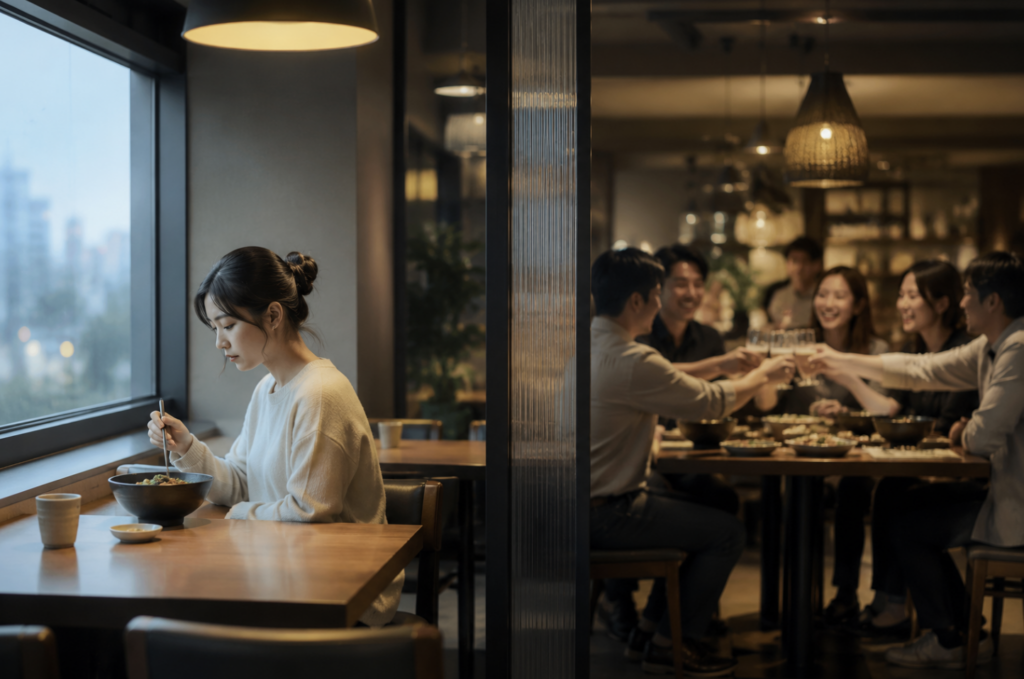
SEOUL, South Korea – In Seoul, where neon-lit alleyways pulse with late-night barbecue smoke and convenience stores now stock single-serving hot pots, dining alone has become both ordinary and oddly contentious.
The latest flashpoint arrived late last year in the southern city of Yeosu, when a noodle restaurant posted a sign that ricocheted across Korean social media: “We don’t sell loneliness.” Solo customers, it added, should either order for two or “bring a friend or spouse.” The backlash was swift. Younger Koreans called it insulting, tone-deaf and economically absurd in a country where living alone is no longer a fringe lifestyle but a demographic reality.
South Korea is now one of the world’s fastest-aging and most single-dominated societies. Single-person households accounted for more than a third of all households in 2024, according to government data, and the number continues to rise. Eating alone — known locally as “honbap,” a combination of the Korean words for “alone” and “meal” — has become so normalized that entire restaurant concepts now revolve around individual diners.
Yet the contradiction reveals something deeper about Korean dining culture: restaurants were historically built around collectivism. Korean barbecue, hot pot and shared side dishes evolved as communal rituals. For decades, walking into a grill house alone carried a faint social stigma, suggesting isolation or lack of social standing. Even today, some traditional establishments remain reluctant to seat singles, especially during peak hours.
How widespread is the practice?
No comprehensive national statistic exists showing what percentage of South Korean restaurants refuse solo diners. Hospitality experts and Korean media reports suggest the phenomenon remains limited rather than mainstream, concentrated mostly in certain categories: Korean barbecue restaurants, communal hot-pot establishments and some small eateries where margins are thin and table turnover is crucial.
In other words, the viral signs generate disproportionate attention precisely because they are increasingly out of step with modern urban life.
Most casual restaurants in Seoul today accept solo diners without issue. Entire neighborhoods — Hongdae, Itaewon, Jongno and Gangnam among them — have seen an explosion of “honbap-friendly” venues featuring counter seating, kiosk ordering systems and one-person set menus. Specialized solo barbecue chains even provide individual grills built into narrow booths.
The geography of exclusion matters
The resistance to solo diners appears strongest not in rural Korea, but in dense urban districts where rent is punishingly high and table space is treated almost like real estate itself. In Seoul’s business districts, a lone customer occupying a four-person barbecue table for 90 minutes can represent lost revenue, particularly if larger groups are waiting outside. Many restaurant owners argue the issue is not prejudice but arithmetic.
Korean barbecue restaurants, in particular, operate on a business model built around group ordering. A table of four may order several rounds of meat, alcohol and side dishes. A single diner ordering one serving can dramatically lower profit per seat. This is why some establishments impose two-serving minimums rather than outright bans.
South Korea is hardly alone
In Spain, parts of Italy and even Britain, solo diners have occasionally encountered resistance at small restaurants, particularly in tourist-heavy districts where tables are scarce and dinner service depends on maximizing occupancy. Parisian bistros have historically preferred couples. High-demand restaurants in New York and London sometimes hesitate to reserve prime tables for single bookings during peak hours. But Asia — particularly South Korea, Japan and China — has become the global laboratory for the opposite trend: designing restaurants specifically for solitary life.
Japan led the movement earliest. Counter-style ramen shops, sushi bars and “salaryman” lunch counters normalized solo dining decades ago, partly because of Tokyo’s extreme urban density and long work hours. Today, many Japanese restaurants naturally accommodate single customers through compact seating design.
China followed with chains like Haidilao, which famously embraced solo hot-pot diners, even placing stuffed animals across empty seats so customers would feel less awkward dining alone. Germany, the United States and Britain have also seen surging numbers of solo reservations since the pandemic, fueled by remote work, shifting relationship patterns and changing attitudes toward solitude. OpenTable reported sharp increases in single-person restaurant bookings in recent years. (Time)
What has changed globally is not simply dining behavior but the meaning attached to it.
For older generations in South Korea, eating alone often carried undertones of social failure. Younger Koreans increasingly see it as autonomy. The broader cultural phenomenon — known as “honjok,” or living alone by choice — now encompasses solo travel, solo drinking and even solo karaoke. Vogue once described Seoul’s “beautiful loners” as emblematic of a new urban identity shaped by independence rather than communal conformity. (Vogue)
Which raises an obvious question: if solo dining is so common, why don’t restaurants simply redesign themselves around flexible seating?
Many already are.
Newer restaurants increasingly use movable two-person tables, counter seating and modular layouts precisely because the economics favor adaptability. Kiosk ordering systems also reduce the awkwardness some solo diners once felt when entering busy establishments alone.
Aging restaurants prevent restructuring
But redesigning older restaurants is not always simple. Much of Seoul’s dining scene operates inside cramped, aging buildings with fixed ventilation systems built around communal grills. Korean barbecue restaurants often require large exhaust hoods and shared cooking surfaces that are difficult to reconfigure into compact solo stations without major renovation costs. In ultra-expensive districts, owners often calculate that serving larger groups remains financially safer than reinventing the layout.
Still, the long-term trajectory appears unmistakable.
The irony of the “We don’t sell loneliness” sign is that many solo diners no longer interpret eating alone as loneliness at all. Increasingly, they see it as convenience, freedom — or simply modern life. And the restaurant industry, whether reluctantly or enthusiastically, is adapting to a world in which the table for one is no longer an exception, but a growing share of the market.