
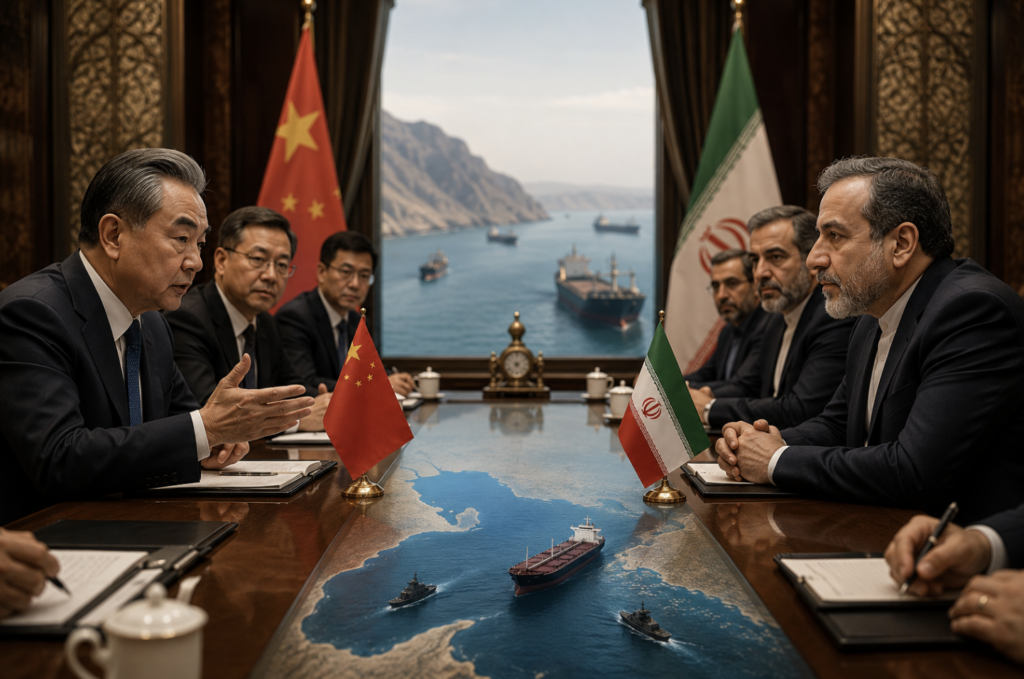
BEIJING, China — China intensified its diplomatic push to stabilize the Middle East on Wednesday, urging Iran to restore navigation through the Strait of Hormuz “as soon as possible” while calling for an immediate and durable ceasefire in the widening regional conflict.
The appeal came during talks in Beijing between China’s foreign minister, Wang Yi, and his Iranian counterpart, Abbas Araqchi, marking Tehran’s highest-level visit to China since the outbreak of the Iran war earlier this year.
Chinese officials framed the Strait of Hormuz crisis as a matter of urgent international concern, underscoring Beijing’s growing anxiety over threats to global energy supplies and maritime trade. Nearly a fifth of the world’s oil passes through the narrow waterway, which has become increasingly inaccessible following reciprocal naval restrictions imposed by Iran and the United States.
“Achieving a comprehensive ceasefire is an urgent priority,” Mr. Wang said, according to a Chinese government readout, adding that renewed hostilities would risk deepening instability across the region. He also emphasized the need to restore “normal and secure navigation” through the Strait, reflecting mounting pressure from oil-importing nations and global shipping markets.
China Walks a Delicate Diplomatic Line
The meeting highlighted China’s increasingly active — though carefully calibrated — role in Middle Eastern diplomacy. Beijing has sought to position itself as a mediator capable of engaging both Tehran and Washington, while avoiding direct military involvement or alignment with either side.
Chinese officials have repeatedly called for renewed negotiations between the United States and Iran and have criticized recent U.S. naval enforcement measures near Iranian ports as “irresponsible and dangerous,” warning that further escalation could undermine the fragile ceasefire brokered earlier this year with support from Pakistan and quiet backing from Beijing.
Iranian state media reported that Mr. Araqchi told Chinese officials bilateral cooperation would “grow even stronger,” reinforcing Tehran’s strategic reliance on Beijing at a time of intensifying Western sanctions and military pressure.
China remains Iran’s largest oil customer despite U.S. sanctions. According to analysts at the Center on Global Energy Policy, China imported roughly 1.38 million barrels of Iranian crude per day in 2025 — approximately 12 percent of its total crude imports — much of it routed through the Strait of Hormuz.
Oil Markets and Global Shipping Remain on Edge
International energy markets reacted cautiously to the latest diplomatic developments. Shipping insurers and commodity analysts have warned that prolonged disruption in the Strait could trigger sustained increases in oil prices, freight costs and inflationary pressures worldwide.
While some commercial traffic has resumed under heavily guarded conditions, maritime security firms say the route remains volatile and vulnerable to renewed confrontation. Several European and Asian governments have quietly urged both Washington and Tehran to establish temporary maritime corridors to protect civilian energy shipments.
Analysts say Beijing’s public intervention reflects not only its dependence on Gulf energy supplies, but also a broader strategic calculation: China increasingly sees regional instability as a direct threat to its economic recovery and global trade ambitions.
Trump-Xi Meeting Expected to Focus on Iran Crisis
The diplomatic activity comes ahead of a closely watched summit between U.S. President Donald Trump and Chinese leader Xi Jinping, expected next week in Beijing.
The meeting, originally scheduled for March but delayed after U.S. and Israeli strikes on Iranian targets, is now expected to center heavily on the Iran conflict, maritime security and energy stability.
Speaking at the White House earlier this week, Mr. Trump praised Mr. Xi’s handling of the crisis, saying China had shown restraint despite its dependence on Gulf oil flows.
“We haven’t been challenged by China,” Mr. Trump told reporters, adding that Mr. Xi “understands the stakes.”
If the trip proceeds as planned, it would mark the first visit to China by a sitting American president in nearly a decade and could become one of the most consequential U.S.-China diplomatic engagements in years.
A Test of China’s Global Influence
For Beijing, the crisis represents both a risk and an opportunity. China has spent years expanding its influence across the Middle East through trade, infrastructure investment and energy partnerships while portraying itself as a more neutral actor than Washington.
But the worsening conflict has exposed the limits of that strategy. Beijing now faces growing expectations from both regional governments and international markets to translate its economic leverage into tangible diplomatic influence.
Whether China can help secure a lasting reopening of the Strait — and prevent the Iran conflict from widening further — may become an early test of its ambitions to act as a global stabilizing power in an increasingly fractured international order.