
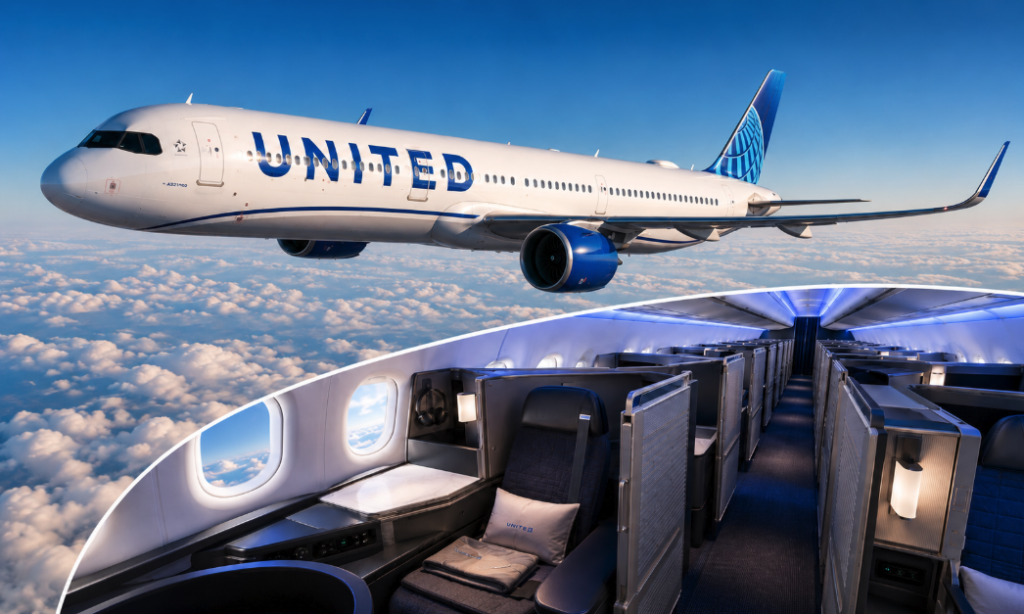
New narrow-body aircraft promises transatlantic reach, lower operating costs and luxury amenities
CHICAGO, USA — United Airlines is preparing to introduce the Airbus A321XLR this summer, marking a significant step in the airline’s strategy to expand international service while capitalizing on growing demand for premium travel experiences. The aircraft, designed specifically for long-range operations, will enable United to operate routes that were previously uneconomical for larger wide-body aircraft while offering passengers an upgraded onboard experience.
The new aircraft will feature United’s latest Polaris Business Class suites equipped with sliding privacy doors and fully flat beds, although the doors cannot be used until certification is granted by the U.S. Federal Aviation Administration (FAA). Economy-class passengers will benefit from a self-service snack bar, while every seat throughout the cabin will offer Bluetooth connectivity, allowing travelers to pair personal wireless headphones with the inflight entertainment system.
The A321XLR forms a central part of United’s new cabin initiative, known as “Elevated,” which will also be introduced across portions of the airline’s Boeing 787 fleet, Airbus A321neo aircraft and regional CRJ550 jets. The strategy reflects a broader industry trend toward premiumization, as airlines increasingly invest in higher-end products to attract travelers willing to pay more for comfort, privacy and enhanced services.
Industry analysts view the A321XLR as one of the most significant commercial aircraft developments of the decade. With a range of approximately 4,700 nautical miles (8,700 kilometers), the aircraft can fly nonstop for up to 11 hours, connecting cities across continents while consuming substantially less fuel than older-generation aircraft. The extended range is achieved through an additional rear center fuel tank integrated into the fuselage.
United plans to use the aircraft primarily as a replacement for its aging Boeing 757 fleet, which entered service in the 1980s and has long been a workhorse on transatlantic routes. Compared with the 757, the A321XLR offers greater fuel efficiency, lower maintenance costs and significantly improved economics, enabling airlines to profitably serve thinner long-haul markets that lack sufficient demand for larger wide-body jets.
According to Patrick Quayle, United’s Senior Vice President of Global Network Planning and Alliances, the aircraft will open opportunities to serve destinations beyond the reach of current narrow-body operations. Potential future markets include Northern Italy, France, Scandinavia and parts of West and North Africa, expanding United’s ability to connect secondary international cities directly with its U.S. hubs.
Industry Implications
The launch comes amid a broader transformation of the global airline industry. Major carriers across North America, Europe and the Middle East are increasingly deploying long-range narrow-body aircraft to establish direct routes between smaller city pairs, bypassing traditional hub-and-spoke connections. Aviation experts say the trend is reshaping international networks by allowing airlines to match capacity more closely with demand while reducing operating costs and emissions.
Market observers also note that premium cabin revenue has become one of the strongest growth drivers for global airlines following the pandemic. As business travel gradually recovers and affluent leisure travelers continue to spend on premium experiences, airlines are investing heavily in private suites, upgraded entertainment systems and enhanced onboard amenities.
For United, the A321XLR represents both a fleet modernization effort and a strategic tool for international expansion. The airline is expected to deploy the aircraft first on select international routes before gradually extending service to destinations across Europe, South America and other long-haul markets. Specific launch routes have not yet been announced.
Outlook
The arrival of the Airbus A321XLR is widely expected to accelerate a global shift toward long-range narrow-body flying. By combining transoceanic capability with lower operating costs and a premium passenger experience, the aircraft offers airlines a new level of flexibility in route planning while giving travelers access to more direct international connections.
As carriers worldwide seek to balance profitability, sustainability and customer expectations, the A321XLR is emerging as a key aircraft in the next generation of international aviation.