
Death of King Vajiralongkorn’s Eldest Daughter Revives Questions About Succession and the Future of Thailand’s Royal House
BANGKOK, Thailand — Thailand is mourning the death of Princess Bajrakitiyabha Narendira Debyavati, the eldest daughter of King Maha Vajiralongkorn, whose passing at age 47 marks the end of one of the most consequential and closely watched royal health crises in modern Thai history.
The princess, widely known as “Princess Pa” and often described by supporters as one of the most capable members of the royal family, died after spending nearly four years in a coma following a sudden medical collapse in December 2022. Thai royal authorities confirmed that her condition had deteriorated significantly in recent months due to severe infections and complications affecting multiple organs.
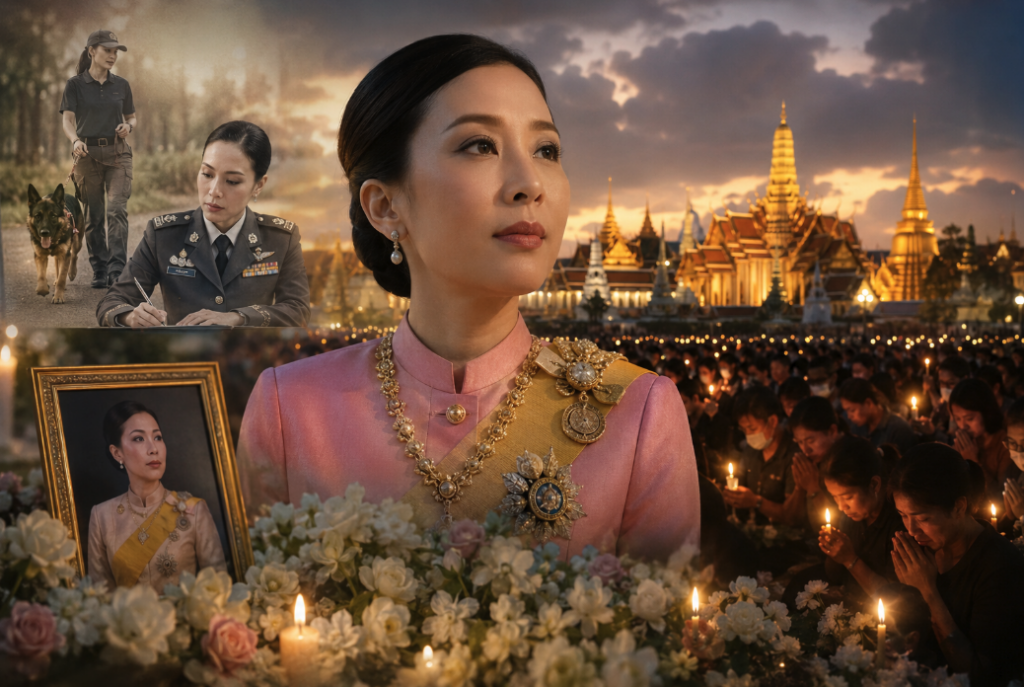
Her death has triggered an outpouring of grief across Thailand, where she was admired not only as a royal figure but also as a lawyer, diplomat, military officer, and advocate for legal reform and women’s rights. Thousands of mourners gathered in Bangkok and across the country as tributes poured in from government leaders, legal institutions, and members of the public.
A Collapse That Changed the Royal Family
On December 14, 2022, Princess Bajrakitiyabha collapsed while participating in military working-dog training in Nakhon Ratchasima province. Palace statements initially attributed the incident to a serious heart condition, although details surrounding the event remained limited. She was airlifted to Bangkok and remained hospitalized thereafter.
Over the following years, official updates were infrequent. Medical bulletins released in 2025 and 2026 revealed that the princess had developed severe bloodstream and abdominal infections, intestinal inflammation, cardiac arrhythmias, abnormal blood clotting, and progressive organ failure. Life-support systems were required to sustain lung and kidney function as doctors fought repeated complications.
In May 2026, the Royal Household acknowledged that a severe infection had become uncontrollable and was affecting multiple organs, signaling a dramatic deterioration in her condition. Three weeks later, the palace announced her death.
A Princess of Unusual Credentials
Born in 1978, Princess Bajrakitiyabha was the only child of King Vajiralongkorn and his first wife, Princess Soamsawali. Educated in Thailand, the United Kingdom, and the United States, she earned advanced legal degrees from Cornell University and built a reputation as one of the most academically accomplished members of the Thai royal family.
Unlike many ceremonial royals, she maintained an active professional career. She served in Thailand’s Attorney General’s Office, represented the country as ambassador to Austria, Slovakia, and Slovenia, and worked closely with the United Nations on rule-of-law and criminal justice initiatives. She became internationally recognized for promoting prison reform and supporting the implementation of the U.N. Bangkok Rules, which focus on the treatment of female prisoners.
Her combination of legal expertise, public service, and royal legitimacy earned her broad respect among many Thais and international observers.
Succession Questions Return to the Forefront
While Thailand has never officially designated Princess Bajrakitiyabha as heir to the throne, many analysts viewed her as one of the monarchy’s most stabilizing figures. Her close relationship with King Vajiralongkorn and her public credibility made her a potential future regent or influential royal adviser.
Her death inevitably renews discussion about succession within the Chakri dynasty, an issue that remains highly sensitive under Thailand’s strict royal defamation laws. King Vajiralongkorn, now 73, has not publicly identified a clear successor. Attention has often focused on Prince Dipangkorn Rasmijoti, the king’s youngest son, though succession arrangements remain uncertain and largely opaque.
Political analysts note that Princess Bajrakitiyabha’s absence removes a respected figure who many believed could help bridge generations within the royal institution during a period of social and political change.
National Mourning and Royal Legacy
The Royal Household has announced traditional funeral rites and state mourning ceremonies. Across Thailand, media organizations have adopted memorial coverage, government officials have offered public tributes, and citizens have gathered to honor a princess remembered for discipline, professionalism, and public service.
For many Thais, Princess Bajrakitiyabha represented a modern vision of monarchy—one rooted less in spectacle than in education, duty, and legal reform. Her death closes a chapter that began with a sudden collapse nearly four years ago and leaves a significant void within one of Southeast Asia’s most influential royal institutions.
As Thailand reflects on her legacy, attention is increasingly turning toward the future of the monarchy itself and the unanswered questions surrounding its next generation of leadership.