
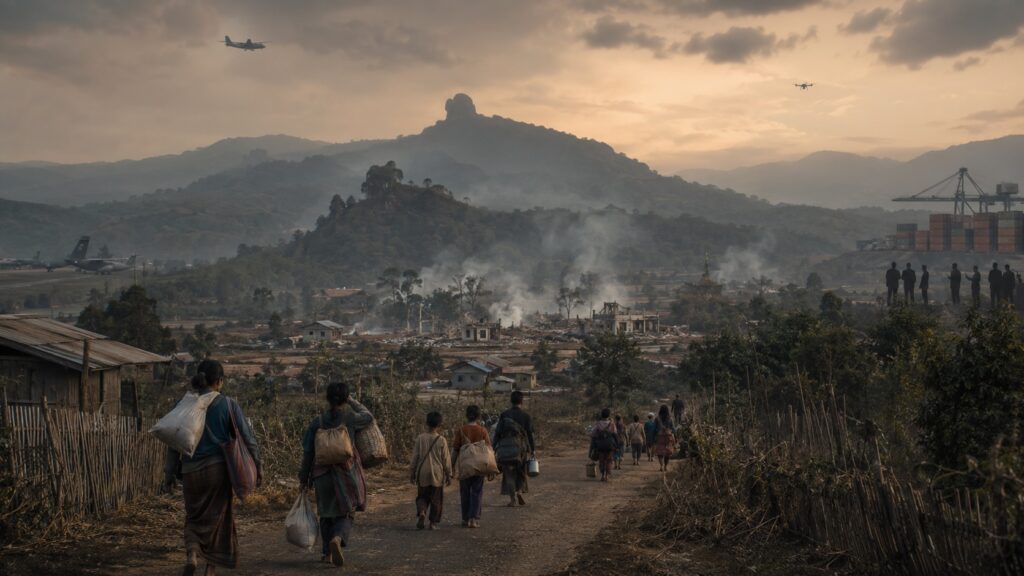
BANGKOK, Thailand — Myanmar’s civil war began as a domestic struggle over military rule, democracy and ethnic autonomy. Five years later, it has developed into an internationalized conflict shaped by weapons, economic interests and diplomatic pressure from some of the world’s most powerful countries.
More than 100,000 civilians and combatants have been killed since the military seized power on Feb. 1, 2021, according to the latest estimates cited by conflict analysts. The Armed Conflict Location & Event Data Project, or ACLED, recorded nearly 93,000 deaths through Jan. 23, 2026; its count subsequently passed 100,000. Because large areas are inaccessible and communications are frequently cut, researchers say the actual toll is probably higher.
The war has displaced more than 3.6 million people and left much of the country divided among the military, ethnic armed organizations and hundreds of local resistance groups. Myanmar is now described by ACLED as the world’s most fragmented conflict, involving more than 1,200 armed factions.
A Deadly Year, With No Reliable National Injury Count
During the first 11 months of 2025, ACLED documented more than 13,700 conflict-related deaths, including civilians and combatants on all sides. That figure excludes deaths caused directly by the March 2025 earthquake.
Civilian figures are narrower and vary according to methodology. United Nations investigators said open sources reported more than 3,220 civilian deaths during 2025, while the Assistance Association for Political Prisoners was able to verify 1,514. More than 4,400 additional reported civilian deaths were still awaiting verification at the end of the year.
There is no credible, comprehensive nationwide figure for the number of people injured during 2025. Hospitals, resistance administrations and ethnic organizations record casualties differently, and many incidents occur in areas under communications blackouts. Any precise national injury total would therefore be misleading.
The available evidence nevertheless points to thousands of injuries. In the first five months of 2026 alone, the United Nations said it had verified that more than 7,000 civilians were killed or injured, without publishing a complete separation between the two categories.
Air Power Becomes the Military’s Central Weapon
The military has increasingly turned to aircraft and drones to compensate for weakened ground forces and territorial losses.
The United Nations recorded 982 civilian deaths from airstrikes in 2025, a 52 percent increase from 2024. Those killed included 232 children and 368 women. Nearly 1,000 people killed by air attacks in a single year represented the highest verified level since the coup.
The escalation has not been geographically uniform. Chinese-brokered ceasefires reduced fighting in parts of northern Shan State, while hostilities intensified in Sagaing, Mandalay, Magway, Rakhine, Bago and Ayeyarwady. Territorial withdrawals or temporary truces should therefore not be interpreted as a nationwide decline in violence.
Russia Supplies Arms; China Seeks Leverage
Russia has been one of the military’s most important weapons suppliers, providing aircraft, helicopters and other systems that reinforce the armed forces’ advantage in the air. Myanmar has continued to commission Russian-made combat aircraft, while also receiving Chinese transport planes and military equipment.
A United Nations investigation previously documented at least $1 billion in arms, dual-use equipment and manufacturing materials supplied to the military after the coup. It identified networks operating in Russia, China, Singapore, India and Thailand. The report distinguished between government-linked transfers from Russia, China and, to a lesser extent, India, and private commercial networks using Singaporean and Thai financial or logistical systems.
China’s role is more complex than that of a conventional military ally. Beijing maintains relations with the government in Naypyidaw while also communicating with powerful ethnic armies along its border.
Chinese pressure helped produce ceasefires with the Myanmar National Democratic Alliance Army and the Ta’ang National Liberation Army. Those agreements enabled the military to return to Lashio and recover parts of a strategically important trade corridor.
Recent regional analysis describes China’s policy as one of “selective stabilization”: Beijing is seeking border security, protected trade routes, access to natural resources and safeguards for Belt and Road projects, rather than a comprehensive democratic settlement.
India Balances Security and Strategic Interests
India has pursued a more cautious policy focused on border security, armed groups operating near its northeastern states and infrastructure projects connecting India with Southeast Asia.
Indian companies, including state-linked entities, have supplied weapons, surveillance equipment and military-use materials. The U.N. investigation identified roughly $51 million in arms-related trade from entities in India through the end of 2022.
At the same time, India has maintained communication with opposition and ethnic actors. Its policy reflects concern that openly isolating Myanmar’s military could strengthen China’s influence or create further instability along the countries’ shared border.
Western Pressure, but Limited Influence
The United States and other Western governments have sanctioned military leaders, state-controlled businesses, arms dealers and aviation-fuel networks. Washington has also provided humanitarian assistance and political support for democratic organizations, including the National Unity Government.
But Western governments have not supplied the resistance with the kind of direct military assistance seen in other international conflicts. Aid reductions and competing global crises have further weakened their influence, leaving democratic and ethnic resistance forces politically supported but militarily isolated.
ASEAN Tests a New Opening
The latest diplomatic shift has come from the Association of Southeast Asian Nations. In July, ASEAN foreign ministers held their first in-person meeting with Myanmar’s top diplomat since the coup. Its special envoy subsequently met ethnic and opposition representatives in Thailand.
Myanmar’s National Unity Government criticized the process after it was excluded from part of the talks. Analysts warned that restoring high-level engagement without securing the release of political prisoners, a reduction in violence or inclusive negotiations could legitimize military rule while surrendering ASEAN’s remaining leverage.
The military-backed administration, now formally led by former junta chief Min Aung Hlaing, presents its elections and proposed talks as a transition toward stability. Opposition organizations reject that account, describing the process as an effort to preserve military control behind a civilian institutional façade.
Myanmar’s war consequently remains domestic in its origins and principal combatants. But its duration, military balance and possible outcome are increasingly influenced from abroad—by Russian weapons, Chinese pressure, Indian security calculations, Western sanctions and an ASEAN diplomatic process struggling to demonstrate that engagement can produce more than legitimacy.
Sources: ASEAN, UN, ISEAS, ACLED