
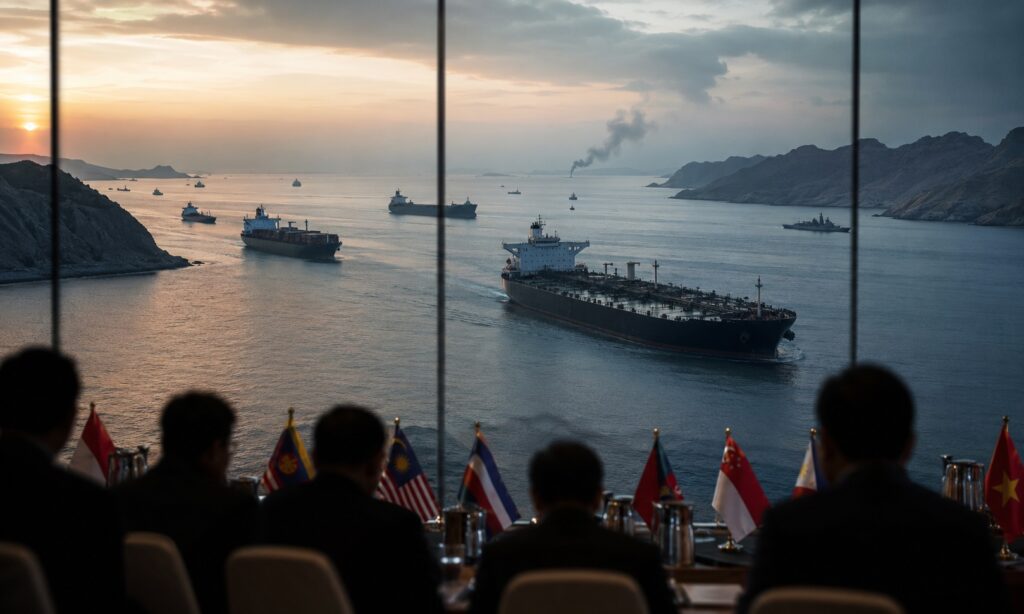
MANILA, Philippines — Foreign ministers from Southeast Asia are preparing to call for freedom of navigation through the world’s international straits, placing access to the Strait of Hormuz at the center of regional diplomacy as the war involving the United States, Israel and Iran disrupts energy supplies across Asia.
A draft communiqué under discussion at meetings of the Association of Southeast Asian Nations in Manila calls for “freedom of navigation in and overflight above straits” and for safe, continuous and “unimpeded” passage through Hormuz. The language, not previously used in this form by ASEAN, reflects mounting concern that control of one strategic waterway could establish a precedent affecting others, including the Strait of Malacca and the Strait of Singapore. The document remained a draft as of July 23.
An Energy Crisis Becomes a Security Issue
The effective closure of Hormuz after joint American-Israeli strikes on Iran has transformed a distant war into an immediate economic emergency for Southeast Asia. The waterway carried about one-fifth of global oil supplies before the conflict, and Asia received the overwhelming majority of the oil and liquefied natural gas shipped through it.
The Philippines, one of the region’s most import-dependent economies, declared a national energy emergency in March after fuel prices rose and officials warned of risks to supply. Other ASEAN governments introduced conservation measures, sought alternative suppliers and explored greater regional coordination.
The International Energy Agency said that the Middle East supplies about 60 percent of Southeast Asia’s crude-oil imports. Nearly half of the petroleum products refined or consumed in the region are derived from Middle Eastern crude. The agency estimates that Southeast Asia’s energy-import bill could reach $160 billion in 2026, underscoring the economic consequences of a prolonged disruption.
Yet ASEAN’s immediate diplomatic response appears more developed than its collective energy response. Although the draft communiqué refers to energy cooperation, ministers have announced little concrete progress on proposals such as regional fuel-sharing arrangements or an expanded ASEAN power grid.
Washington Warns Against a Precedent
Secretary of State Marco Rubio told ASEAN representatives that allowing Iran to determine which vessels may use Hormuz would create a “dangerous precedent.”
“There is a fundamental principle about freedom of navigation that is threatened,” Mr. Rubio said, presenting the issue as broader than the current Middle East conflict.
Washington also sought to reassure Southeast Asian governments that its renewed diplomatic engagement with Beijing would not weaken its regional alliances. “We’re not going to abandon our allies,” Mr. Rubio said after meeting Chinese Foreign Minister Wang Yi.
The American position connects two geographically distant disputes: the blockade of Hormuz and restrictions on navigation in the South China Sea. ASEAN governments, however, have traditionally resisted being drawn directly into great-power rivalries. Their draft statement therefore emphasizes international law and open passage while also calling for restraint in the Middle East.
South China Sea Negotiations Face a Credibility Test
The Manila meetings were also overshadowed by fresh confrontations between Chinese and Philippine vessels in disputed waters. The encounters prompted both governments to summon diplomatic representatives and renewed questions about whether ASEAN and China can finish their long-delayed Code of Conduct for the South China Sea.
China’s ambassador to the Philippines, Jing Quan, said the clashes had not changed Beijing’s intention to conclude negotiations before the end of 2026. He described the proposed code principally as a framework establishing “rules of engagement,” rather than a mechanism for resolving competing territorial claims.
Malaysian Foreign Minister Mohamad Hasan expressed greater urgency, saying he expected an agreement to be completed by the ASEAN leaders’ summit in Manila in November.
That timetable remains uncertain. Negotiations have continued for years, and analysts have repeatedly questioned whether a consensus document would be legally binding, contain an effective enforcement mechanism or apply consistently across disputed waters. The code’s credibility will depend less on the announcement of an agreement than on its geographical scope, legal status and ability to restrain conduct at sea.
ASEAN’s Broader Dilemma
The two maritime crises have exposed the same vulnerability: Southeast Asian economies depend on open sea lanes, but the region has limited power to guarantee them.
In Hormuz, ASEAN faces the consequences of a conflict over which it has little direct influence. In the South China Sea, its members are negotiating with a far more powerful neighbor while remaining divided over security relationships and territorial claims.
The emerging communiqué is therefore significant as a statement of principle. But without practical energy-sharing mechanisms in Southeast Asia—and enforceable safeguards in the South China Sea—it may also demonstrate the limits of ASEAN diplomacy at a moment when events beyond the region are testing its economic resilience and strategic autonomy.
Sources: AFP, Reuters, International Energy Agency