
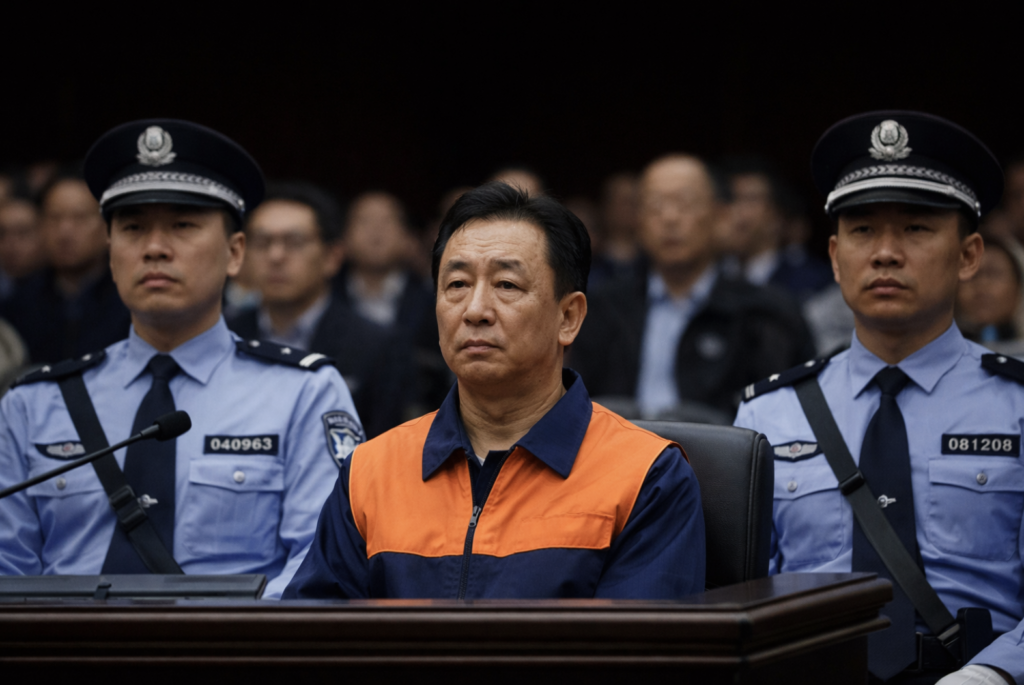
SHENZHEN, China — Hui Ka Yan, the once-celebrated founder of China Evergrande Group, pleaded guilty this week to charges including embezzlement and corporate bribery, in a closely watched case that has come to symbolize the unraveling of China’s debt-fueled property boom.
Appearing before a court in Shenzhen on April 13 and 14, Mr. Hui expressed remorse during public proceedings, according to state media. The court said a verdict would be announced at a later date.
His admission marks a turning point in a crisis that has rippled through China’s financial system, rattling domestic banks, eroding investor confidence and exposing structural weaknesses in one of the country’s most critical economic sectors.
A Collapse Years in the Making
Once valued at more than $50 billion, Evergrande stood at the center of China’s real estate expansion, a sector that for decades accounted for roughly a quarter of the nation’s economic activity when related industries are included. At its peak, the company managed more than 1,300 projects across 280 cities.
But its rapid ascent was built on staggering leverage. By 2021, Evergrande had accumulated more than $300 billion in liabilities, making it the world’s most indebted property developer. Its collapse that year triggered a broader downturn in China’s housing market — one that continues to weigh on growth, consumer confidence and local government finances.
Court proceedings revealed that presale funds collected from homebuyers — a cornerstone of China’s property financing model — were diverted away from construction and into new projects. The practice left hundreds of developments unfinished, fueling public anger and mortgage boycotts across the country.
Regulatory Reckoning in Beijing
The company’s downfall followed a decisive policy shift in 2020, when Beijing introduced strict borrowing limits — the so-called “three red lines” — aimed at curbing excessive debt among developers. Analysts say the measures, while necessary, exposed the fragility of firms like Evergrande that had relied heavily on continuous borrowing to sustain growth.
In recent months, Chinese authorities have moved to stabilize the sector through targeted lending support, relaxed purchase restrictions and efforts to ensure the delivery of pre-sold homes. Yet recovery has been uneven, with property sales and prices still under pressure in many cities.
Mr. Hui’s guilty plea is widely viewed by analysts as part of a broader campaign to restore discipline in financial markets. “This case reflects both accountability and a warning,” said regional economists, noting that Beijing appears intent on deterring similar excesses while managing systemic risk.
From Riches to Ruin
Known also as Xu Jiayin, Mr. Hui rose from modest beginnings in rural China to become one of Asia’s wealthiest individuals. At his peak in 2017, his fortune was estimated at $42.5 billion.
His empire extended beyond real estate into electric vehicles, consumer goods and professional sports, including ownership of a championship-winning football club. But as Evergrande’s finances deteriorated, these ventures faltered.
In 2024, regulators fined Mr. Hui $6.5 million and barred him for life from China’s capital markets after investigators found the company had overstated revenues by tens of billions of dollars.
By the time Evergrande’s shares were delisted from the Hong Kong exchange in August 2025, its market value had collapsed by more than 99 percent.
Global Implications
The Evergrande crisis has had far-reaching consequences beyond China’s borders. International investors, many of whom held the company’s offshore bonds, have faced steep losses amid a complex and prolonged restructuring process.
Economists warn that the property sector’s prolonged weakness continues to act as a drag on China’s broader economic recovery, complicating efforts to boost domestic demand and stabilize growth.
Mr. Hui’s case, analysts say, may serve as a defining moment — not only in assigning responsibility for one of the largest corporate collapses in modern history, but also in shaping the next phase of China’s economic governance.
A System Under Strain
As China seeks to rebalance its economy away from debt-driven growth, the legacy of Evergrande looms large. The guilty plea of its founder underscores the costs of unchecked expansion — and the challenges Beijing faces in restoring confidence in a sector that once symbolized the country’s rise.