
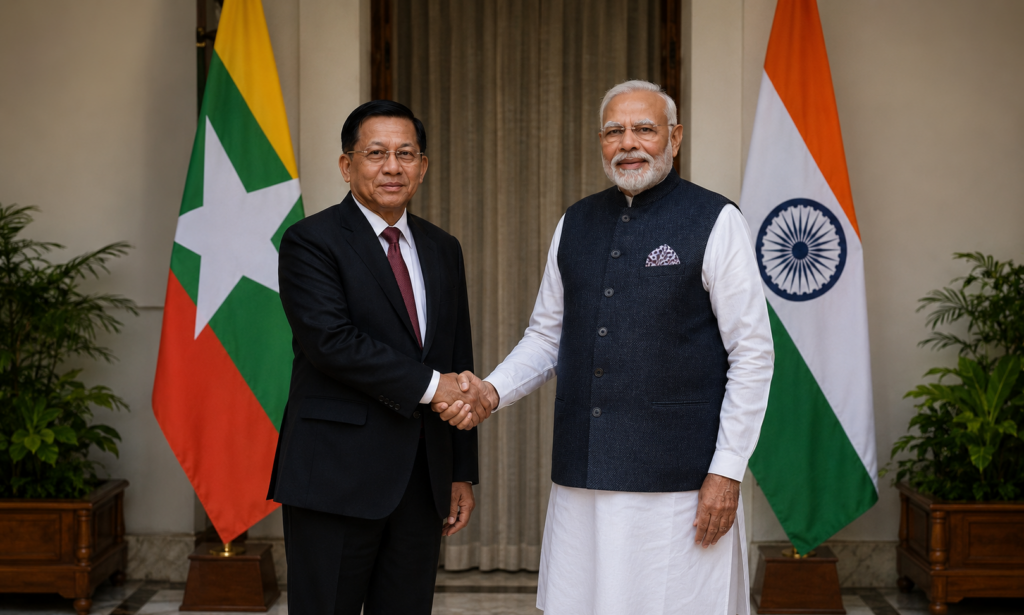
Modi and Min Aung Hlaing deepen cooperation on security, trade and critical minerals while democracy concerns remain unresolved
NEW DELHI, India — In a visit carrying implications far beyond bilateral relations, Myanmar President Min Aung Hlaing held extensive talks with Indian Prime Minister Narendra Modi this week, signaling a new phase in New Delhi’s engagement with Myanmar’s military-backed government amid an ongoing civil war and growing geopolitical competition in Asia.
The five-day visit marks Min Aung Hlaing’s first foreign trip since assuming the presidency in April following elections that were widely criticized by opposition groups, Western governments and democracy advocates as neither free nor inclusive. The polls, held between late 2025 and early 2026, were dominated by military-aligned parties after many opposition candidates were barred from participating and voting was impossible in large conflict-ridden regions.
Yet despite international skepticism, India rolled out the diplomatic red carpet.
At talks in New Delhi, the two leaders agreed to expand cooperation in trade, border security, connectivity projects, defense, maritime security, cybersecurity, rare earths and critical minerals — sectors that have gained strategic importance as global powers race to secure supply chains and reduce dependence on China.
A Strategic Relationship Recalibrated
India’s outreach reflects a hard geopolitical reality: Myanmar remains central to New Delhi’s “Neighbourhood First” and “Act East” policies, serving as India’s land bridge to Southeast Asia and a critical buffer along a 1,643-kilometer border.
Officials from both countries emphasized the need to accelerate long-delayed connectivity initiatives, including transport corridors linking India to Southeast Asia. Security cooperation also featured prominently, with Myanmar assuring India that its territory would not be used for activities threatening Indian interests.
For New Delhi, concerns extend beyond diplomacy. Fighting in Myanmar since the 2021 military coup has fueled refugee flows into India’s northeastern states and complicated efforts to combat insurgent movements operating across porous border regions.
The talks also highlighted growing interest in Myanmar’s deposits of rare earth minerals, resources increasingly viewed as strategic assets amid intensifying competition between major powers. Analysts see India’s push into the sector as part of a broader effort to diversify supply chains traditionally dominated by China.
Democracy Remains the Unfinished Question
Behind the public displays of cooperation, Myanmar’s political crisis remains unresolved.
In February 2021, Min Aung Hlaing, then commander-in-chief of the armed forces, overthrew the elected government of Aung San Suu Kyi after her party won a landslide election victory. The coup triggered mass protests that evolved into a nationwide armed resistance and one of Asia’s most complex civil wars.
Five years later, large areas of Myanmar remain outside the military’s effective control. The conflict has killed thousands, displaced millions and devastated the economy.
India’s Foreign Secretary, Vikram Misri, said Prime Minister Modi raised broader democratic issues during the discussions, including the situation of Aung San Suu Kyi, who remains under strict detention. India reiterated support for an inclusive political process involving all stakeholders and argued that continued engagement offers a better path toward stability than diplomatic isolation.
Balancing China While Managing Instability
The visit comes as regional powers reassess their approach to Myanmar.
China remains the military government’s most influential external partner, but India appears increasingly determined to prevent Beijing from becoming Myanmar’s sole strategic patron. Analysts view Min Aung Hlaing’s decision to make India his first foreign destination as an effort to diversify international relationships and gain broader legitimacy after years of diplomatic isolation.
The timing is significant. Across Asia, governments are confronting growing uncertainty stemming from supply-chain competition, maritime security concerns and rival infrastructure initiatives. Myanmar’s location between South and Southeast Asia makes it a pivotal actor despite its internal turmoil.
For India, the challenge is balancing democratic principles with strategic necessity. For Myanmar’s military-backed government, the challenge is far greater: convincing neighbors and the wider world that political normalization is possible while a brutal civil war continues at home.
The Broader International Reaction
Western governments have largely maintained a cautious stance toward Myanmar’s new administration, arguing that the recent election did little to diminish military dominance. Human rights organizations continue to accuse the authorities of suppressing political opposition and restricting democratic participation.
Nevertheless, India’s engagement suggests that regional powers are increasingly prioritizing stability, border security and economic interests over isolation strategies. The New Delhi summit may therefore represent more than a bilateral meeting; it could signal the emergence of a new regional consensus that engagement, rather than exclusion, is the preferred approach toward Myanmar’s embattled leadership.