
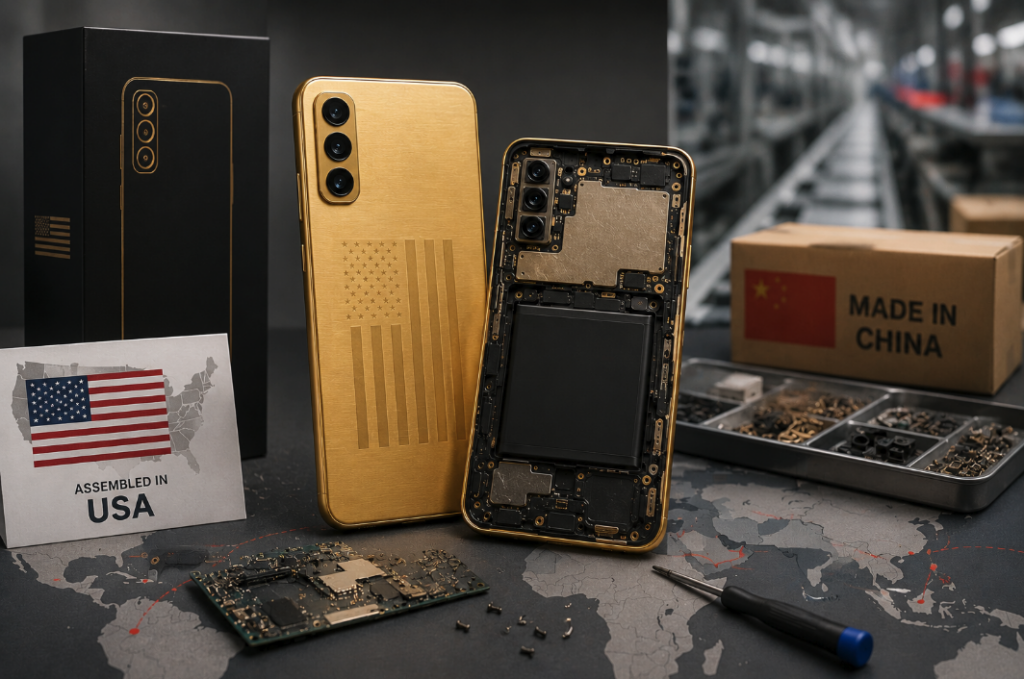
Investigation by iFixit Raises Questions About U.S. Manufacturing Claims
WASHINGTON, USA — The Trump Mobile T1 smartphone, promoted as a symbol of American manufacturing and patriotism, has been revealed to be almost entirely identical to the HTC U24 Pro, a mid-range smartphone introduced in 2024 and manufactured through Asian supply chains, according to a detailed teardown by repair specialists at iFixit.
The findings challenge the device’s marketing narrative as a distinctly American product and reignite debate over the feasibility of large-scale U.S. smartphone manufacturing.
A Patriotic Product Under the Microscope
Marketed with slogans such as “Proudly American,” the Trump Mobile T1 was presented as a consumer electronics product aligned with efforts to revive domestic manufacturing.
To verify those claims, iFixit conducted a comprehensive forensic analysis that included CT scans, component inspections, and a full teardown of the device. Investigators then compared the T1 directly with the HTC U24 Pro, a smartphone released in 2024.
Their conclusion was striking: the two devices were nearly identical internally.
Internal Components Reveal an Almost Perfect Match
According to iFixit, the Trump Mobile T1 shares the same motherboard layout, internal architecture, component placement, display assembly, and hardware configuration as the HTC U24 Pro.
The similarities were so extensive that engineers were able to swap major components between the two phones and create a functioning hybrid device.
Microscopic examination further confirmed that both smartphones use the same Samsung OLED display panel, reinforcing the conclusion that they originate from the same hardware platform.
The discovery leaves little room for interpretation that the T1 is a newly developed smartphone.
Cosmetic Changes, but Little Technical Innovation
Most of the differences identified during the teardown were external rather than functional.
The Trump-branded version features a gold-colored finish, a slightly modified speaker grille design, and minor adjustments to the placement of the camera flash module.
The most significant hardware change is the battery. The T1 uses a slightly larger battery sourced from Philippine manufacturer Newlix Mfg Inc., but charging performance has been reduced from 60 watts on the HTC model to 30 watts on the Trump-branded device.
For consumers, this means longer charging times despite the increased battery capacity.
Manufacturing Claims Face Scrutiny
The findings have also drawn attention to the company’s marketing language.
Early promotional materials suggested that the device was “Made in USA.” More recent packaging instead states that the phone is “Proudly Assembled in the USA.”
Industry observers note that the distinction is important. Under U.S. Federal Trade Commission guidelines, products marketed as “Made in USA” must be composed almost entirely of domestically sourced components and manufacturing processes.
Based on the teardown analysis, iFixit believes the T1 does not meet those standards.
The company suggests that any U.S.-based manufacturing likely consists of limited final assembly operations, while key components—including the display, chassis, circuit boards, and electronics—appear to originate overseas.
A Broader Debate About American Manufacturing
The controversy arrives at a time when policymakers from both political parties have emphasized reshoring manufacturing and reducing dependence on foreign supply chains.
Yet experts argue that smartphones remain among the most globally integrated products in the world. Critical components are sourced from dozens of suppliers across Asia, while manufacturing relies on highly specialized ecosystems that have developed over decades.
Analysts note that creating a fully American-made smartphone would require substantial investment, extensive supplier networks, and years of industrial development.
The Trump Phone controversy therefore highlights the gap between political messaging and the realities of modern electronics production.
Price, Value and Repairability
The Trump Mobile T1 is priced at $499, placing it squarely in the mid-range smartphone segment.
The HTC U24 Pro, on which the device appears to be based, sells for roughly the same price through various retailers, meaning consumers are not paying a substantial premium for the rebranded version.
However, iFixit criticized both devices for poor repairability.
The organization assigned each phone a repairability score of 3 out of 10, citing a lack of service manuals, limited spare parts availability, and design choices that make repairs difficult and costly.
Such characteristics, critics argue, contribute to electronic waste and shorten product lifespans.
Political Branding Meets Global Supply Chains
Beyond the technical findings, the Trump Mobile T1 illustrates a growing trend in which consumer products are marketed through political identity and national branding.
Supporters may view the device as a symbolic expression of American values and domestic industry. Critics, however, argue that the teardown demonstrates how deeply globalized modern technology remains.
Regardless of branding, the smartphone’s components, manufacturing processes, and supply chain connections appear to span multiple countries and continents.
The investigation serves as a reminder that in the technology sector, patriotic messaging often collides with the practical realities of global production.