
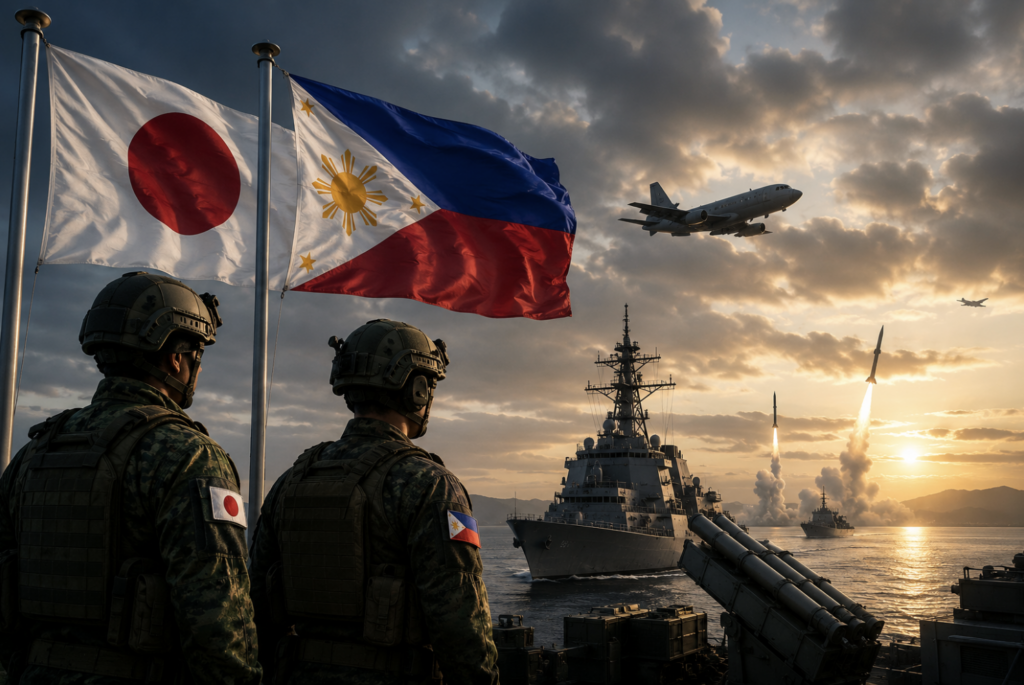
TOKYO, Japan — Japan and the Philippines moved significantly closer this week to what analysts increasingly describe as a new strategic military partnership aimed at reshaping the balance of power in the Indo-Pacific, following reports that Tokyo is considering exporting anti-ship missile systems to Manila for the first time.
The development follows a broader overhaul of Japan’s defense export rules announced in April — the most consequential change to the country’s arms policy in decades — allowing Japanese manufacturers to sell missiles, warships and other military equipment abroad.
According to Reuters and Japan’s public broadcaster NHK, Japan’s Defense Ministry is evaluating the possible transfer of Type-88 surface-to-ship missile systems to the Philippines, a move that would have been politically unthinkable only a few years ago.
The proposed missile exports come amid intensifying maritime tensions between China and several U.S.-aligned nations in East and Southeast Asia. Military planners increasingly view the Philippines and Japan’s southwestern islands as critical parts of the so-called “First Island Chain,” a strategic arc stretching from Japan through Taiwan to the South China Sea that could constrain Chinese naval access to the Pacific.
A Historic Break With Japan’s Postwar Defense Tradition
For decades after World War II, Japan maintained strict self-imposed limits on military exports under its pacifist constitution and postwar security doctrine. But rising regional instability — driven by China’s military expansion, North Korean missile activity and growing uncertainty around Taiwan — has steadily transformed Tokyo’s strategic posture.
The administration of Prime Minister Sanae Takaichi has taken a particularly assertive approach, arguing that a conflict involving Taiwan could directly threaten Japan’s national survival. Beijing has sharply criticized those remarks and warned against what Chinese officials describe as a regional “militarization trend.”
Chinese President Xi Jinping reportedly warned U.S. President Donald Trump this week that mishandling tensions over Taiwan could push U.S.-China relations into “a dangerous place,” further underscoring the increasingly volatile geopolitical climate surrounding the region.
Manila Accelerates Military Modernization
The Philippines, under President Ferdinand Marcos Jr., has rapidly expanded defense cooperation with Japan, the United States and Australia in response to repeated confrontations with Chinese vessels in the South China Sea.
Japanese Defense Minister Shinjiro Koizumi confirmed earlier this month that Tokyo and Manila had agreed to deepen defense technology cooperation under a newly established framework for defense equipment transfers.
In addition to missile discussions, Japan is reportedly preparing the early transfer of Abukuma-class destroyers and TC-90 surveillance aircraft to the Philippine armed forces.
Defense officials from both countries have also established working groups to coordinate operational requirements, logistics and future procurement mechanisms.
Military analysts in Tokyo and Manila say the cooperation reflects a long-term strategic realignment rather than a single arms deal.
Regional and International Reactions
The emerging Japan-Philippines security partnership has received quiet but strong support from Washington, which has sought to strengthen a network of allied security relationships across the Indo-Pacific.
Recent joint military exercises involving Japan, the United States, Australia and the Philippines included live-fire drills using Japanese Type-88 anti-ship missiles — widely interpreted as a demonstration of Tokyo’s expanding military role.
Regional observers note that Japan is increasingly positioning itself not only as a technological and economic power, but also as a defense supplier capable of competing with established arms exporters from the United States, South Korea and Europe. Reuters reported that countries including Indonesia and Poland are also exploring Japanese defense procurement opportunities.
China, however, has voiced growing concern over Japan’s military normalization and its expanding security partnerships in Southeast Asia. Chinese officials have repeatedly argued that such alliances risk destabilizing the region and intensifying bloc-based confrontation.
A Broader Strategic Transformation in Asia
Security experts increasingly compare the evolving Japan-Philippines partnership to the early stages of a broader Indo-Pacific security architecture linking Japan, the Philippines, the United States, Australia and potentially India into a loosely coordinated strategic framework focused on deterrence against China.
The cooperation builds upon the Reciprocal Access Agreement (RAA), a bilateral defense pact signed in 2024 and fully implemented in 2025, allowing Japanese and Philippine forces to conduct joint exercises, deployments and logistical operations on each other’s territory.
While no final missile export contract has yet been formally announced, analysts say the political symbolism alone marks a turning point in modern Asian security affairs.
What once would have been viewed as extraordinary — Japanese missiles, destroyers and military aircraft being transferred to a Southeast Asian ally — is now becoming part of a rapidly changing regional order shaped by intensifying great-power rivalry across the Indo-Pacific.