
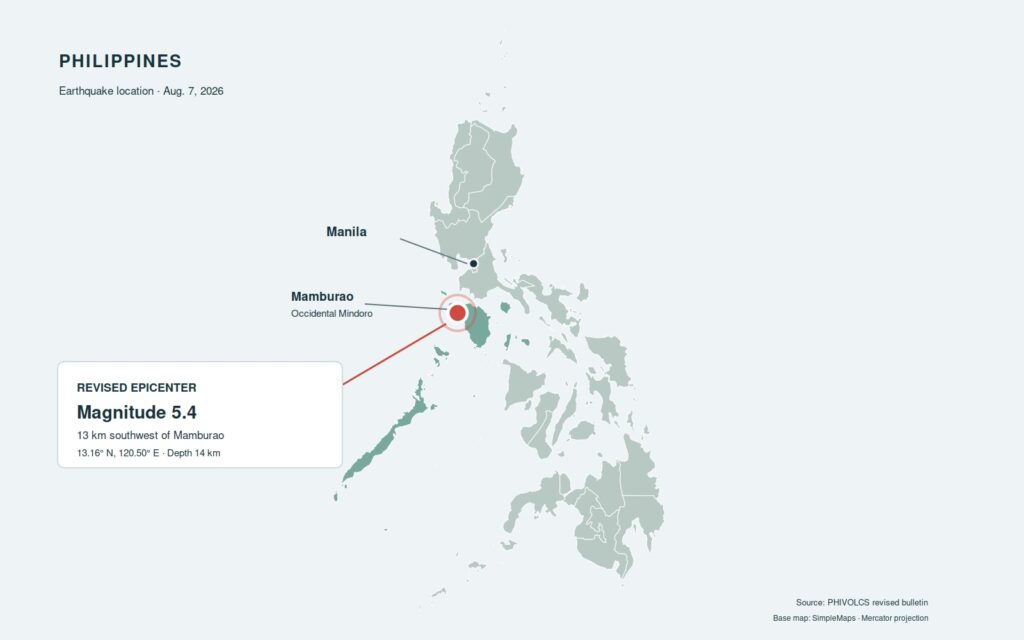
MANILA, Philippines — A shallow earthquake struck off the Philippine island of Mindoro on Friday morning, shaking communities near the epicenter and swaying buildings in metropolitan Manila, but producing no immediate reports of casualties or significant damage.
The Philippine Institute of Volcanology and Seismology, or PHIVOLCS, said the tectonic earthquake occurred at 10:38 a.m. on Aug. 7, about 13 kilometers southwest of Mamburao, the capital of Occidental Mindoro. Its depth was estimated at 14 kilometers.
An initial bulletin placed the magnitude at 5.8, the epicenter about 21 kilometers from Mamburao and the depth at 10 kilometers. After receiving additional seismic data, PHIVOLCS revised the event to a moment magnitude of 5.4 and refined its location and depth—a routine process after earthquakes, as readings from more monitoring stations become available.
Strongest Shaking Reported Across Mindoro
Intensity V, classified by PHIVOLCS as “strong,” was reported in Mamburao and in several Oriental Mindoro communities, including Calapan City, Naujan, Puerto Galera, San Teodoro and Victoria.
Intensity IV shaking reached Taal in Batangas and the Occidental Mindoro municipalities of Abra de Ilog and Sablayan. Intensity III tremors were reported in Quezon City, Batangas City, General Trias in Cavite and San Pedro in Laguna. Weaker shaking was recorded in Parañaque and parts of Laguna and Quezon Province.
PHIVOLCS instruments broadly supported the public reports, recording Intensity V in Mamburao and Puerto Galera and Intensity III in Quezon City and several other locations. The agency said aftershocks were possible but that damage was not expected.
Precautionary Evacuations in the Capital
The tremor was clearly felt in office buildings in Manila, according to witnesses cited by Reuters. Employees in at least one state agency building were directed outside as a precaution, illustrating how even moderate offshore earthquakes can disrupt activity far from their epicenters.
International reports initially carried the magnitude-5.8 assessment, while later Philippine coverage reflected PHIVOLCS’s revised measurement. No tsunami warning was issued, and authorities had reported no major disruption by Friday afternoon.
Recent Earthquakes Were Not One Connected Sequence
Friday’s earthquake followed significant seismic activity near southern Mindanao on Aug. 5 and 6, creating the appearance of three consecutive days of notable tremors in the Philippines. But PHIVOLCS said the Mindoro and Mindanao events were not connected.
The Mindanao earthquakes occurred in a different part of the archipelago and included activity associated with the continuing offshore Sarangani sequence. The Mindoro earthquake arose from a separate tectonic source. Their proximity in time does not, by itself, indicate that one triggered the other, according to the agency’s analysis.
The succession nevertheless renewed attention to the Philippines’ persistent seismic exposure. The country lies along the tectonically active Pacific Ring of Fire and is crossed or bordered by numerous faults and trenches. Earthquakes are consequently common, although most are too weak or too remote to cause serious damage.
For residents, PHIVOLCS’s immediate guidance remained limited but clear: prepare for possible aftershocks, inspect buildings if damage becomes apparent and follow official safety instructions rather than treating geographically separate earthquakes as evidence of an escalating nationwide sequence.
Sources: Reuters, ABS-CBN News