
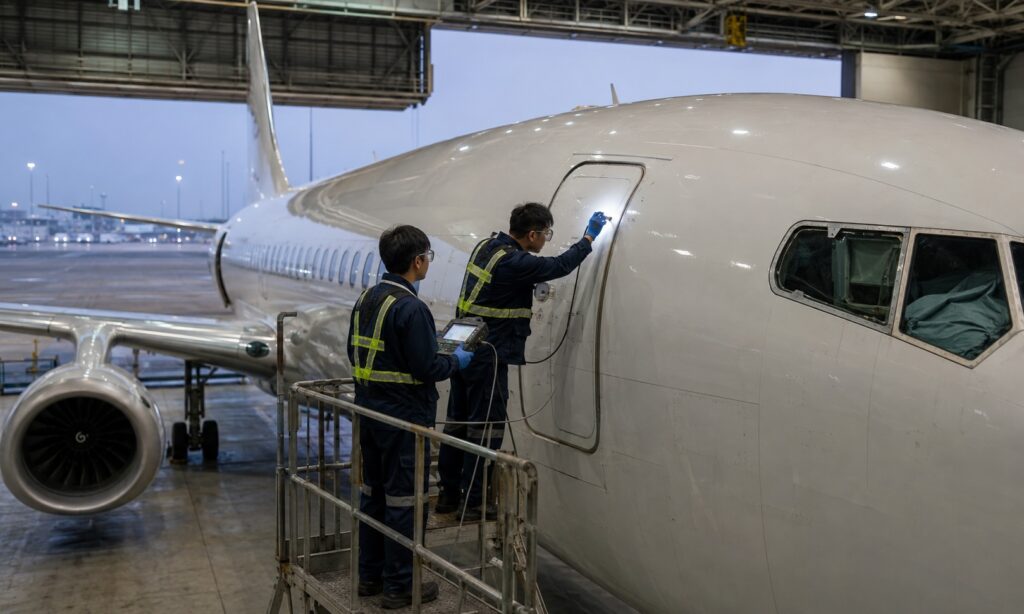
WASHINGTON, USA — The Federal Aviation Administration has ordered airlines to inspect hundreds of Boeing 737 Max jets for possible cracking around a structural reinforcement near the forward galley door, extending safeguards first developed after damage was discovered on older generations of the 737.
The final rule covers certain 737-8, 737-9 and high-capacity 737-8200 aircraft. It directly applies to 471 airplanes registered in the United States; the F.A.A. has said the potentially affected population totals about 1,429 aircraft worldwide. The directive becomes effective Sept. 10, although the timing of individual inspections will depend on each aircraft’s accumulated flights and prior repairs.
No cracking has been found on a 737 Max, according to Boeing and the F.A.A. The reported damage occurred on earlier 737 Next Generation aircraft, but the Max shares enough of the same fuselage design and manufacturing process that regulators concluded the condition could eventually develop there as well.
A Structural Concern, but Not an Immediate Grounding
The area under scrutiny is the “bear strap,” a metal reinforcement surrounding the upper corner of the forward galley door opening on the right side of the fuselage. Such reinforcements redistribute the stresses created by large openings in a pressurized aircraft body.
Repeated takeoffs, landings and cabin-pressurization cycles can concentrate stress near the corners of those openings. If a crack in the fuselage skin or bear strap were allowed to grow beyond a critical length, the F.A.A. said, the structure might no longer withstand its certified operating loads.
Operators must first examine the fuselage for existing repairs. Depending on the aircraft’s condition, airlines may then be required to conduct detailed inspections and high- or low-frequency eddy-current tests capable of detecting surface and subsurface cracking. Any crack must be repaired using an approved method before the aircraft returns to service. Some inspections will be repeated at intervals specified in Boeing’s maintenance instructions.
The agency rejected calls for earlier inspections or an immediate fleetwide grounding. Responding to the Foundation for Aviation Safety, which questioned whether the compliance schedule was sufficiently conservative, the F.A.A. said its engineering analysis provided several opportunities to discover a crack before it became critical. The regulator characterized that schedule as providing an acceptable level of safety.
Airlines Expect Limited Disruption
Southwest Airlines said it was reviewing the order and would inspect affected aircraft according to the F.A.A.’s timetable. United Airlines said it expected to perform the work during scheduled heavy-maintenance visits and did not anticipate a near-term effect on its operations, noting that its oldest Max jets had not yet accumulated enough flight cycles to require immediate inspection.
United had also participated in the rule-making process, asking the F.A.A. to clarify how previous fuselage repairs should be treated. The agency concluded that even minor “blend-out” repairs must be evaluated because they may require shorter inspection intervals.
The financial impact is expected to be modest unless cracks are discovered. The F.A.A. estimated an initial visual inspection would cost $85 per airplane. More detailed and eddy-current examinations could cost as much as $340 per aircraft during each inspection cycle, or about $160,000 across the affected American fleet. The agency could not estimate repair costs because they would depend on what inspectors find.
Boeing Traces the Program to Earlier 737s
Boeing said it began alerting operators to related bear-strap cracking on 737 Next Generation aircraft in 2019. The F.A.A. imposed mandatory inspections on those older models in 2021 and later expanded the requirements as additional structural evidence emerged. Boeing extended its own inspection guidance to the Max in 2024.
The company supports the new directive and said it has analyzed the cracking mechanism and is introducing manufacturing changes intended to prevent the condition on aircraft still in production.
The distinction between detection and prevention is important: the order does not establish that Max aircraft are already cracked. It represents a damage-tolerance measure based on findings from the older fleet and the possibility that aircraft with comparable structures could develop the same fatigue damage over time.
International Reach
Because Boeing is an American manufacturer and the United States is the state of design, the F.A.A. directive also carries regulatory weight abroad. The European Union Aviation Safety Agency listed the order in its safety-publications system on Aug. 7. Under European rules, foreign state-of-design directives are automatically applicable in EASA member countries on their effective date unless the European regulator issues a different decision.
No separate grounding or more restrictive order from a major foreign regulator had been announced as of Aug. 7. Airlines outside the United States will nevertheless have to comply where their national or regional airworthiness systems adopt or recognize the F.A.A.’s requirements.
Renewed Scrutiny of Boeing’s Quality Controls
The directive arrives amid continuing examination of Boeing’s manufacturing and regulatory oversight. In January 2024, a door plug separated from an Alaska Airlines 737-9 shortly after takeoff. The National Transportation Safety Board later found that four securing bolts had been missing before the aircraft was delivered and attributed the accident to inadequate training, guidance and oversight at Boeing, as well as ineffective F.A.A. oversight of recurring production problems.
The bear-strap issue is technically distinct from that accident, and no evidence links the two. But the history amplifies the reputational consequences of even routine airworthiness actions involving the Max.
The F.A.A. also proposed a separate rule in July covering 453 Max aircraft after reports that some passenger seats may not have been properly secured to their tracks. That proposal remains open for public comment and is not part of the fuselage inspection order.
For passengers, the immediate operational effect is expected to be limited. For Boeing and its regulators, however, the directive underscores a broader challenge: demonstrating that potential defects are identified and corrected before they become accidents rather than afterward.
The precise number of Asian-operated aircraft covered by the directive has not been publicly released because applicability is determined by the serial-number list in Boeing’s operator bulletin, not simply by model. Of the 1,429 aircraft estimated to be affected worldwide, 958 are registered outside the United States, including planes operated in Asia, Europe, Latin America, Africa, Canada and the Middle East. Indian industry sources have so far identified about 19 Akasa Air jets as likely to require checks, but airlines and regulators in China, Indonesia, Malaysia, Singapore, South Korea and other Asian markets had not released comparable figures as of Aug. 7. The final Asian total is therefore expected to be higher than the 19 aircraft publicly identified, but no authoritative regional figure is yet available.
Foreign-operated aircraft will not have to travel to Boeing or to the United States. Inspections can be performed at an airline’s maintenance base or an approved maintenance, repair and overhaul facility, typically during scheduled overnight or heavy-maintenance visits. The F.A.A. estimates one work-hour for the initial visual examination and up to four work-hours for detailed and eddy-current testing; allowing for preparation, access and documentation, Boeing has described the routine process as an overnight job when no damage is found. Because compliance is staggered according to flight cycles and maintenance history, the worldwide fleet will be inspected over time rather than all at once. Any aircraft found with a crack must remain out of service until repaired, and neither the F.A.A. nor Boeing has estimated how long such repairs might take.
Sources: FAA, N.T.S.B., EASA, CBS News