
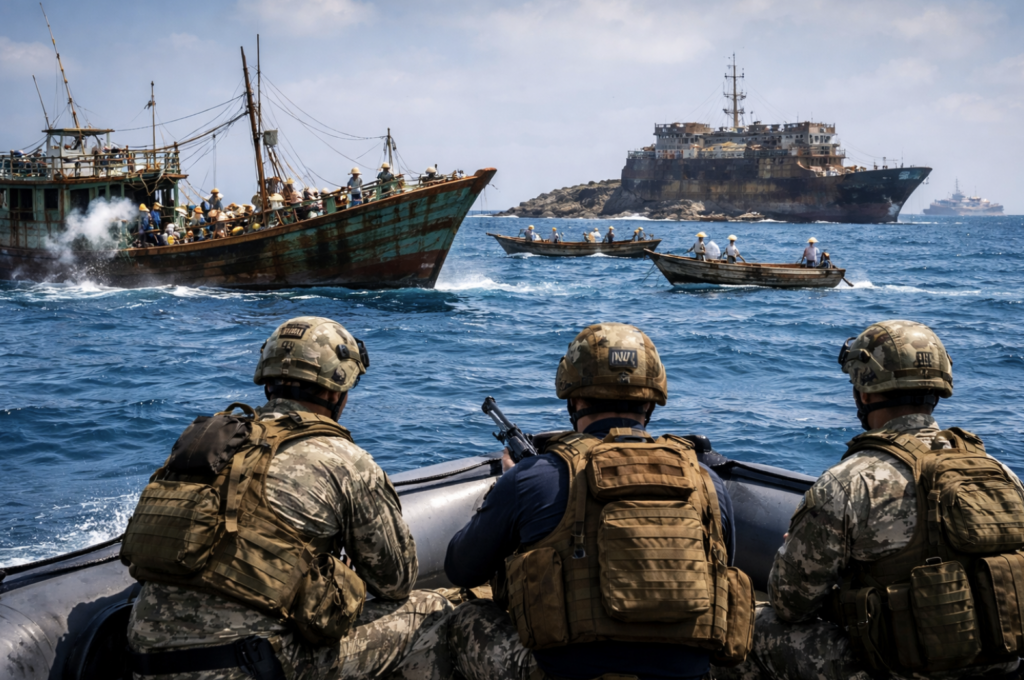
MANILA, Philippines – The Philippines has accused Chinese fishermen of using cyanide to poison waters near the Spratly Islands, a disputed region in the South China Sea, in what Manila described as a deliberate act of “sabotage.” Philippine officials say the alleged activity, concentrated around Second Thomas Shoal, was intended to destroy marine life and undermine food supplies for Filipino troops stationed aboard the BRP Sierra Madre, a grounded naval vessel symbolizing Manila’s territorial claim.
China has forcefully denied the accusations. A spokesperson for the Chinese Foreign Ministry dismissed them as “completely unbelievable,” countering that Philippine forces have instead harassed Chinese fishing vessels operating lawfully in the area.
Evidence, Denials, and Environmental Concerns
Philippine security officials say troops recovered cyanide bottles from small boats linked to Chinese fishing fleets over multiple incidents in 2024. Laboratory tests reportedly confirmed the presence of cyanide in nearby waters. Cyanide fishing, long condemned across Southeast Asia, is illegal due to its devastating effects on coral reefs and marine ecosystems.
Independent maritime analysts note that while cyanide fishing has historically occurred in the region, attributing responsibility remains difficult without third-party verification. Environmental groups, however, warn that even isolated incidents could have long-term ecological consequences in one of the world’s most biodiverse marine zones.
A Dispute Rooted in Geography and Power
The incident unfolds against the backdrop of overlapping territorial claims involving China, the Philippines, Vietnam, Malaysia, Brunei, and Taiwan. The Spratly Islands and surrounding waters are not only rich fishing grounds but also sit atop potential energy reserves and vital global shipping lanes.
China continues to assert sweeping claims over most of the sea despite a 2016 international arbitration ruling that found no legal basis for those claims—a decision Beijing has rejected. The Philippines, by contrast, bases its claim largely on geographic proximity and international law.
Rising Military Friction and International Response
Tensions in the area have intensified in recent months. A violent encounter in June 2024 saw Chinese coast guard personnel clash with Philippine sailors near Second Thomas Shoal, injuring several. Beijing has also repeatedly attempted to block Philippine resupply missions to the Sierra Madre.
In response, Manila has strengthened defense ties with allies. Joint maritime exercises involving the United States and Australia have recently taken place in contested waters, with Japan set to participate fully in upcoming drills. France has also agreed to deploy a small contingent of troops for joint exercises later this month.
Western and regional analysts view these developments as part of a broader shift toward increased multilateral security cooperation aimed at countering China’s growing assertiveness. Beijing, however, has criticized the exercises as destabilizing and accused external powers of inflaming regional tensions.
A Test of Law, Ecology, and Regional Stability
The cyanide fishing allegations—whether proven or not—underscore the fragile intersection of environmental protection and geopolitical rivalry in the South China Sea. As competing claims intensify and military activity increases, the dispute is increasingly seen not only as a territorial conflict but also as a test of international law, ecological stewardship, and the balance of power in the Indo-Pacific.