
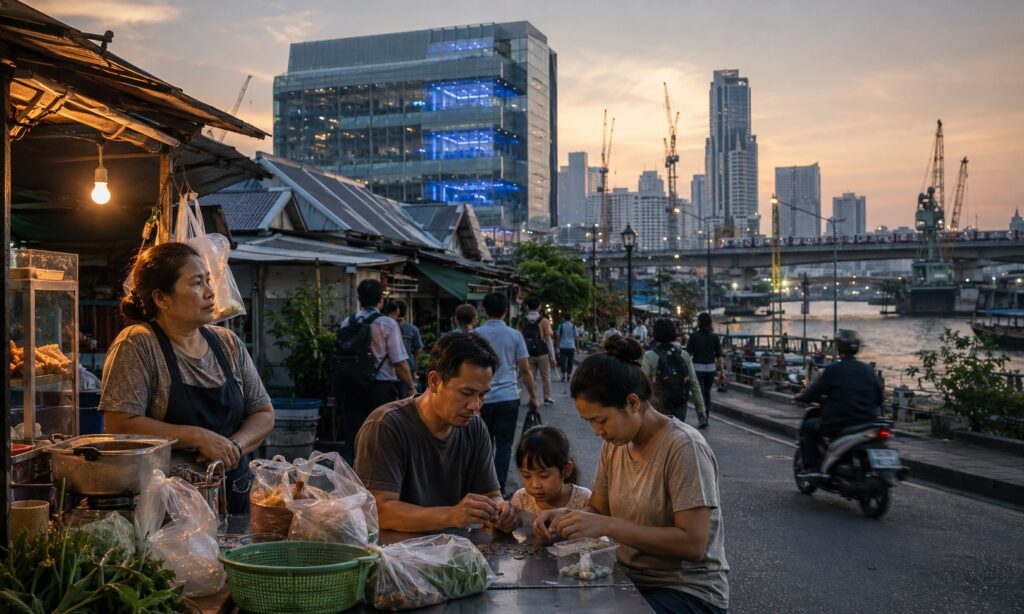
BANGKOK, Thailand — Thailand’s economy grew faster than economists expected in the second quarter, but the numbers tell a less reassuring story for the households and small businesses that sustain much of the country.
Gross domestic product rose 1.9 percent from a year earlier, down from 2.8 percent in the first quarter. Compared with the preceding three months, the economy actually contracted 0.2 percent.
The government nevertheless raised the lower end of its full-year growth forecast, projecting an expansion of 2.0 to 2.5 percent. Behind that improved outlook is a powerful but narrow engine: investment in artificial intelligence, electronics, data centers and other technology-linked industries.
The question confronting policymakers is whether that momentum can reach beyond industrial parks and corporate balance sheets to improve the finances of ordinary Thais.
A Technology Boom With Limited Reach
Private investment surged 13.4 percent, its strongest growth in more than a decade, as companies expanded spending on equipment, electronics production and digital infrastructure. Goods exports rose 17.6 percent, helped by global demand for computer components and other technology products.
Yet Thailand’s broader manufacturing sector barely grew. Output increased just 0.1 percent, while factory utilization fell to approximately 57.5 percent.
One explanation is that the fastest-growing export industries depend heavily on imported components and machinery. Imports climbed far more rapidly than exports, contributing to a quarterly current-account deficit of approximately $17.7 billion.
The result is an unusual disconnect: Thailand is selling more abroad and attracting major investment, but a significant share of the economic value is absorbed by imported inputs or concentrated among larger companies.
Kasikorn Research Center identified another reason for caution. Its assessment concluded that the stronger-than-expected quarterly result was driven partly by inventory accumulation, a potentially temporary factor rather than evidence of stronger underlying consumer demand. The research firm maintained its full-year growth forecast at 2 percent.
For Households, Growth Is Harder to See
Consumer spending rose 1.9 percent, a substantial slowdown from 3.3 percent in the first quarter. Higher energy and food costs, weak income growth and debt have left many families with little room for discretionary purchases.
Household debt stood at approximately 85.9 percent of GDP in the first quarter. Even when earnings improve, loan payments and basic expenses can absorb much of the gain.
In an assessment published August 22, Siam Commercial Bank’s Economic Intelligence Center described Thailand’s recovery as increasingly divided between technology-linked corporations and households or small businesses struggling with weak demand and limited access to credit.
The center also warned that a declining household-debt ratio does not necessarily mean families are financially healthier: tighter lending standards and reduced borrowing can lower the ratio even as access to financing becomes more difficult. It projects growth of 2 percent in 2026 and 1.9 percent in 2027.
For workers, the official unemployment rate of 0.96 percent offers only partial reassurance. Employment figures do not capture the full strain facing informal workers, self-employed traders and provincial businesses confronting stagnant incomes or reduced working hours.
Tourism and Agriculture Offer Uneven Relief
Foreign arrivals fell 4.4 percent in the second quarter, even as higher spending by visitors supported tourism revenue.
That distinction matters. Premium hotels and businesses catering to affluent travelers may prosper, while smaller operators dependent on high visitor volumes continue to struggle.
Agriculture presents a similar divide. Farm output increased modestly, and overall agricultural income improved, but expensive fertilizer, volatile weather and uneven crop performance continue to weigh on rural communities.
The government estimates that Thailand has approximately 7.7 million farming households, representing nearly 30 percent of all households, yet agriculture generates less than 9 percent of GDP.
That imbalance illustrates why stronger headline growth can coexist with persistent financial pressure outside Bangkok and major industrial centers.
International Forecasts Remain Divided
Domestic and international analysts disagree over how durable the improvement will be.
The Bank of Thailand projects growth of 2.3 percent this year. Singapore-based OCBC upgraded its forecast to 2.4 percent, citing stronger data-center investment and better-than-expected economic activity.
Other institutions remain more cautious. The Asian Development Bank’s July forecast was 1.8 percent, while the Organization for Economic Cooperation and Development projected 1.7 percent in its June outlook.
Those differences partly reflect the timing of each assessment, but they also highlight the central uncertainty: whether Thailand’s investment boom will generate lasting domestic demand or fade as government support weakens and external risks intensify.
Thailand also remains behind regional competitors. Vietnam’s economy grew 8.4 percent in the second quarter, while Indonesia expanded by approximately 5.3 percent.
A Government With Less Room to Spend
The policy response is already taking shape.
On August 19, Commerce Minister Suphajee Suthumpun outlined a strategy focused on tourism, agriculture, small businesses and international trade, with particular emphasis on linking Thai suppliers to global production networks and increasing local economic benefits.
Prime Minister Anutin Charnvirakul has also promoted the government’s Thailand FastPass initiative to accelerate investment approvals in advanced manufacturing, clean energy and digital industries.
But the government’s options are constrained. Public debt is approaching 67 percent of GDP, close to Thailand’s 70 percent ceiling.
A 400-billion-baht emergency borrowing program has helped support households and the energy transition. The central bank estimates that those measures could add approximately 0.5 percentage points to growth this year, but their expiration may weigh on growth in 2027.
The OECD has urged Thailand to keep financial assistance targeted and temporary while concentrating longer-term efforts on productivity, competition and renewable energy.
Monetary policy also offers limited room for maneuver. The central bank’s benchmark interest rate stands at 1 percent, and Kasikorn Research expects policymakers to hold it there at their August 26 meeting and potentially through the rest of the year. Lower rates can support the economy, but they do little for borrowers whom commercial banks consider too risky to finance.
The broader challenge extends beyond avoiding a downturn. As Thailand prepares to host the International Monetary Fund and World Bank annual meetings in October, it faces a more difficult test: turning investment in future industries into higher wages, stronger small businesses and economic security for the people its growth figures are supposed to represent.
Sources: World Bank, Nation Thailand, Thai government, Bank of Thailand