
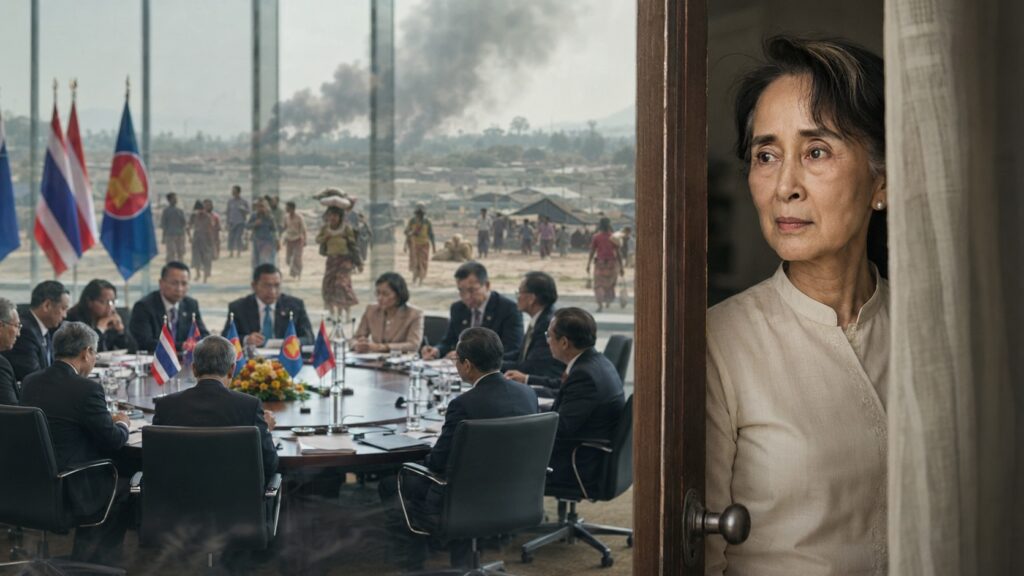
BANGKOK, Thailand— Thailand is urging Myanmar’s military-backed government to permit a senior Southeast Asian envoy to meet Aung San Suu Kyi, presenting the request as an early test of whether renewed regional diplomacy can produce tangible concessions after years of war and political repression.
Thai Foreign Minister Sihasak Phuangketkeow said ASEAN hoped Maria Theresa Lazaro, the Philippine foreign minister and the bloc’s special envoy for Myanmar, would receive direct access to Ms. Aung San Suu Kyi during a planned humanitarian mission before the ASEAN summit in November.
Myanmar’s foreign minister, Tin Maung Swe — not Than Swe, as stated in the original draft — did not reject the request during informal talks in Bangkok, according to Mr. Sihasak. But Myanmar’s authorities have made no public commitment to allow a meeting.
The appeal comes as Thailand leads an effort to draw Myanmar back into regional diplomacy, arguing that isolation has failed to curb a conflict that has killed more than 100,000 people since the military seized power in February 2021.
Suu Kyi’s Condition Remains Unverified
Ms. Aung San Suu Kyi, now 81, is serving a 27-year sentence following a partial commutation of convictions widely denounced by her supporters as politically motivated. Myanmar’s government has said she is in good health and has reportedly placed her under house arrest, but her precise location and condition have not been independently confirmed.
She has not been seen publicly or granted access to her family, chosen lawyers or independent diplomats for years. The claim in the original article that she was definitively transferred to a residence in Naypyidaw should therefore be qualified: credible reporting describes her whereabouts as unknown or unverified.
At the July 12 meeting, Mr. Tin Maung Swe reportedly referred to Ms. Aung San Suu Kyi as “a sister” who would be cared for. Mr. Sihasak responded that direct access was necessary to verify those assurances.
First Face-to-Face ASEAN Contact Since the Coup
The Bangkok gathering marked the first in-person meeting between ASEAN foreign ministers and Myanmar’s chief diplomat since the 2021 coup. Myanmar’s political leaders had been excluded from the bloc’s highest-level meetings because of their failure to implement ASEAN’s Five-Point Consensus.
That plan calls for an end to violence, dialogue among all parties, humanitarian assistance and mediation by an ASEAN envoy. It has produced little measurable progress.
Following the ministerial meeting, Ms. Lazaro and Thai officials met separately with representatives of six ethnic armed organizations, including the Karen National Union and Karenni National Progressive Party, as well as Myanmar’s military-backed National Solidarity and Peacemaking Negotiation Committee.
Mr. Sihasak said the participants broadly accepted that the war could not be settled militarily. Thailand has offered to facilitate preliminary discussions and provide a venue, although the sides have not agreed on a common negotiating framework.
Opposition Questions ASEAN’s Approach
Myanmar opposition organizations have reacted cautiously and, in some cases, angrily. A coalition of 20 political and ethnic groups said ASEAN was expanding high-level contact with a government that had repudiated the bloc’s own peace framework while failing to engage fully with democratic forces.
The National Unity Government, formed by lawmakers and officials removed after the coup, was not included in the latest meetings. Myanmar-based Democratic Voice of Burma also described the talks as controversial, while reporting that several prominent ethnic armed organizations attended the closed-door consultations.
Analysts similarly warn that restoring Myanmar’s regional standing before it releases political prisoners or reduces military attacks could surrender ASEAN’s limited leverage. Richard Horsey of the International Crisis Group said it would be a mistake to bring Myanmar “back into the fold” without obtaining meaningful concessions.
Casualties: What Can Reliably Be Said
The conflict is not a year old. It has continued for more than five years since the February 2021 coup.
ACLED’s latest cumulative assessment recorded 100,114 conflict-related deaths across all sides by July 2026. For the most recent complete reporting period, ACLED counted more than 13,700 conflict-related deaths between Jan. 1 and Nov. 28, 2025.
The United Nations reported more than 3,220 civilian deaths in 2025, though only 1,514 had been individually verified by the Assistance Association for Political Prisoners by year’s end. At least 982 civilians were killed in airstrikes alone, including 232 children.
There is no reliable nationwide total for people injured during either 2025 or the entire post-coup conflict. Fighting in inaccessible areas, communications blackouts and the collapse of local medical reporting make a defensible aggregate impossible. Any article giving a precise national injury figure without a defined dataset would be misleading.
Normalization Without a Political Transition
Min Aung Hlaing, who led the coup, became president in April after military-controlled elections from which meaningful opposition was excluded. International analysts describe the resulting administration as civilian in form but still dominated by the armed forces.
His expected official visit to Thailand in August would be another significant step toward regional normalization. For Bangkok, renewed contact may offer a route to negotiations and humanitarian access. For Myanmar’s opposition, however, diplomacy that produces recognition without political prisoners’ release, reduced violence or inclusive talks risks reinforcing the order created by the coup.
Access to Ms. Aung San Suu Kyi would therefore carry significance beyond confirming her health. It would indicate whether Myanmar’s government is prepared to make even a limited concession—or whether ASEAN’s latest diplomatic opening will repeat the frustrations of the past five years.
Sources: Reuters, UN