
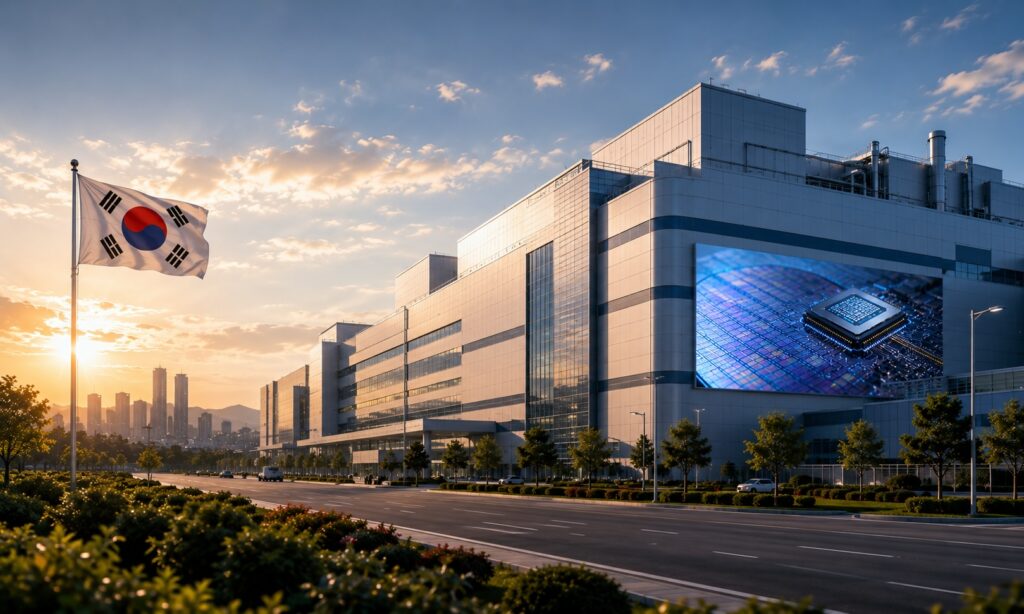
SEOUL, South Korea — South Korea has unveiled one of the world’s most ambitious industrial strategies, committing to a sweeping long-term investment program aimed at reinforcing its dominance in semiconductors, accelerating artificial intelligence development and reshaping the country’s economic geography.
President Lee Jae-myung announced the initiative alongside executives from Samsung Electronics and SK Hynix, outlining what the government calls the “Three Mega Projects for the Great Leap Forward.” The strategy combines public support with unprecedented private-sector investment in semiconductor manufacturing, AI data centers and physical AI technologies such as robotics.
Government officials estimate the broader initiative could mobilize well over 1,000 trillion won (approximately US$650 billion) over the coming decade, while associated AI infrastructure projects could push cumulative investment beyond US$1 trillion by the mid-2030s, making it one of the largest technology investment programs ever announced by a single country.
A New Industrial Map Beyond Seoul
Rather than expanding existing manufacturing around the Seoul metropolitan area, the government intends to build new semiconductor ecosystems across southwestern and central South Korea.
Samsung and SK Hynix plan to construct multiple advanced fabrication plants, while new chip packaging facilities and AI infrastructure will be developed in additional regions. The government argues that decades of industrial concentration around Seoul have widened regional economic disparities and slowed national growth.
“This is not simply an industrial policy,” President Lee said, describing the initiative as essential to South Korea’s long-term economic survival and balanced regional development.
AI Becomes National Strategy
At the center of the program is an aggressive effort to position South Korea among the world’s leading AI economies.
Officials identified three strategic pillars:
- Advanced semiconductor manufacturing
- AI data center infrastructure
- Physical AI and robotics
The government plans to develop large-scale AI data centers capable of supporting future generative AI applications while investing heavily in high-bandwidth memory (HBM), one of the most critical components powering today’s AI accelerators.
South Korea also aims to become one of the world’s leading robotics powers by 2030, commercializing humanoid robots across major industries and training approximately 10,000 AI robotics specialists over the next five years.
Samsung and SK Hynix Double Down
The announcement further cements the central role of Samsung Electronics and SK Hynix in the global AI supply chain.
Together, the companies dominate the worldwide market for advanced memory chips used in AI servers and are among Nvidia’s key suppliers. Explosive demand from cloud computing companies has driven record earnings for both firms over the past year.
Under the new strategy:
- Samsung plans major investments in new fabrication facilities and advanced HBM production.
- SK Hynix will expand memory production while participating in new regional semiconductor hubs and AI infrastructure projects.
The investments are expected to be implemented over many years and remain subject to market conditions and corporate board approvals.
Global AI Competition Intensifies
South Korea’s announcement reflects a broader international race to secure leadership in AI infrastructure.
Governments across Asia—including Taiwan, China and Japan—have expanded support for semiconductor manufacturing, while the United States continues to subsidize domestic chip production through industrial policy.
At the same time, major technology companies including Microsoft, Amazon, Google and Meta are collectively expected to spend hundreds of billions of dollars this year expanding AI infrastructure, creating extraordinary demand for advanced semiconductors. That surge has tightened global chip supply and increased production costs across the electronics industry.
Domestic Response: Optimism Mixed With Questions
Within South Korea, the announcement has largely been welcomed by business groups and regional governments, which view the projects as a once-in-a-generation opportunity to attract investment and high-value manufacturing outside the capital.
However, domestic analysts have also highlighted several challenges:
- Building sufficient power, water and transportation infrastructure for new fabrication plants.
- Recruiting enough highly skilled engineers outside the Seoul metropolitan area.
- Avoiding future oversupply if global AI demand moderates.
- Ensuring investment decisions remain commercially sustainable rather than politically driven.
Financial markets reflected some of those concerns, with shares of Samsung and SK Hynix easing following the announcement despite the scale of the investment plans.
The Bigger Picture
South Korea’s latest strategy illustrates how AI has evolved beyond a technology trend into a cornerstone of national industrial policy.
As countries compete to secure semiconductor capacity, AI infrastructure and advanced manufacturing, governments are increasingly treating chip production as a matter of economic resilience and national competitiveness.
For South Korea, whose economy has long depended on technological leadership, the new investment drive represents more than an expansion of manufacturing—it is an attempt to redefine the country’s next phase of growth while reducing its dependence on the Seoul metropolitan region.
Whether the initiative delivers on its promise will depend not only on the continued strength of global AI demand, but also on South Korea’s ability to build the infrastructure, workforce and innovation ecosystem required to sustain leadership in an increasingly competitive semiconductor industry.