
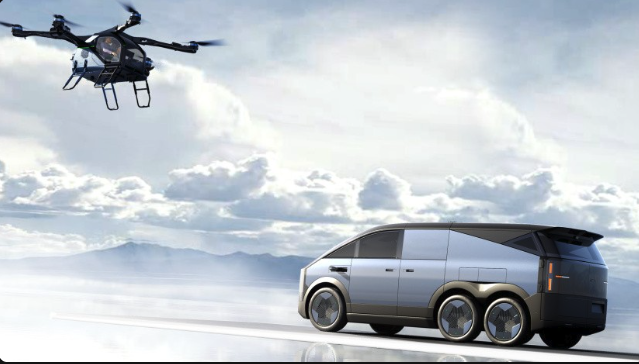
MUNICH, China — XPeng, the Chinese electric-vehicle manufacturer, brought one of its most futuristic creations to Germany this month: a six-wheeled vehicle carrying a compact electric aircraft that can emerge from the rear compartment, unfold its rotors and take off vertically.
The system, called the “Land Aircraft Carrier,” combines a large ground vehicle with a detachable, two-seat electric vertical-takeoff-and-landing aircraft, or eVTOL. XPeng displayed it at the company’s Brand Day and global product presentation in Munich on July 16, an event centered on the international introduction of the L03, its new lower-priced SUV coupe.
The appearance marked the aircraft carrier’s first major presentation in Germany, but not — as some reports asserted — its first journey outside Asia. XPeng AeroHT, since renamed Aridge, displayed the same modular concept at CES 2025 in Las Vegas. XPeng itself described that appearance as the model’s “overseas debut,” while the Consumer Technology Association listed the vehicle among the prominent products shown at the exhibition.
Nor is there evidence that the aircraft conducted a public flight in Munich. Reports and images document a presentation of the vehicle and its flight module. Descriptions of the aircraft “rolling out and taking off” refer to its intended operation rather than necessarily to a demonstration flight in Germany.
A Vehicle and an Aircraft — With Separate Regulatory Challenges
The ground component is approximately 5.5 meters long and uses three axles, six-wheel drive and rear-wheel steering. Although it is often described simply as an electric vehicle, it incorporates a range-extender system: electric motors drive the wheels, while a combustion engine can generate electricity for the battery.
Inside the rear section is a lightweight, carbon-fiber aircraft with two seats and six rotors. XPeng says it is being developed with manual and automated flight modes, simplifying operation for customers with limited aviation experience.
The company has cited recreational travel, tourism, pilot training and emergency services among its potential uses. But the unusual configuration does not eliminate aviation requirements. The aircraft and the ground carrier would need to satisfy separate European rules covering airworthiness, road approval, pilot qualifications, flight operations, insurance and authorized takeoff and landing areas.
No version has yet been approved for routine operation on German roads and in European airspace. Initial production and deliveries are intended for China.
XPeng says the project has accumulated more than 7,000 advance orders or purchase commitments, up from more than 3,000 reported at CES in January 2025. A dedicated Chinese factory has been designed for annual production of as many as 10,000 units. These figures are company claims; the composition of the orders, deposits and cancellation provisions has not been publicly detailed.
Why Munich Mattered
The flying vehicle was not the commercial center of the Munich event. That role belonged to the L03, the first XPeng model to receive its global introduction outside China.
The L03 will be offered in battery-electric and range-extender versions. German prices start at €35,600 for the battery-electric model and €38,600 for the extended-range version — considerably higher than its Chinese price but competitive with European electric SUVs such as Tesla’s Model Y and models from Volkswagen, BMW and Audi.
XPeng selected Munich for several overlapping reasons.
The company operates a European research and development center there, giving it access to Germany’s automotive engineering and software talent. It is also working with Magna Steyr to manufacture vehicles in Austria and has said that it is examining additional European production, potentially using underutilized German factories. Those discussions remain at an early stage.
Munich also carries symbolic weight. It is BMW’s home, a major center for automotive engineering and the host city of the IAA Mobility exhibition. Presenting Chinese vehicles, robots and aircraft there allowed XPeng to cast itself not merely as an exporter competing on price, but as a prospective technology leader entering the center of Europe’s automotive establishment.
Selling “Physical AI,” Not Just Cars
The Munich production was designed to broaden XPeng’s identity. Alongside the L03 and the aircraft carrier, the company presented humanoid robots, proprietary artificial-intelligence processors and advanced driver-assistance systems under the theme “Physical AI for All.”
XPeng’s chairman and chief executive, He Xiaopeng, argues that cars will increasingly become “robots on four wheels.” The company’s longer-term plans encompass robotaxis, humanoid robots, AI processors and aircraft as well as conventional passenger vehicles.
The aircraft carrier consequently served as a “halo product”: a dramatic machine intended to attract attention to the broader engineering platform, even though European sales and operation remain distant. The strategy resembles the use of racing cars or experimental concepts by established manufacturers, but with AI and robotics replacing motorsport as the principal demonstration of technical ambition.
Enthusiasm in China, Caution Abroad
Chinese coverage has generally framed the Munich event as a milestone in the globalization of the country’s intelligent-vehicle industry. Commentators emphasized that the L03 was designed for sale in dozens of markets and that XPeng was attempting to move beyond the traditional model of building cars in China and simply exporting them.
The international response has been more divided. Analysts recognize XPeng’s rapid progress in charging, vehicle software, driver assistance and interior technology. The L03’s pricing and specifications could make it a credible competitor in Europe’s increasingly crowded electric-SUV market.
But some reviewers point to advantages that established rivals retain. Tesla still possesses a larger customer base, a more mature software ecosystem and an extensive proprietary charging network. European manufacturers, meanwhile, have deeper service networks, stronger brand recognition and more experience with local regulation.
XPeng’s expansion is also driven by pressure at home. Intense competition and prolonged price cutting in China have made overseas growth increasingly important. The company returned to a loss in early 2026 after recording its first quarterly profit in late 2025, according to international reporting.
A Demonstration of Intent, Not an Imminent European Flying Car
The Munich appearance should therefore not be interpreted as confirmation that German customers will soon be able to purchase and fly the Land Aircraft Carrier.
Its more immediate message was strategic: XPeng wants European consumers, regulators and industrial partners to see it as a global AI and mobility company rather than another Chinese electric-car entrant.
Whether that image can be converted into a durable European business will depend less on the spectacle of a folding aircraft than on ordinary but difficult matters — vehicle pricing, software reliability, safety certification, service coverage and customers’ willingness to trust a relatively unfamiliar brand.
For now, the Land Aircraft Carrier is best understood as both a genuine engineering program and a carefully chosen symbol of XPeng’s ambitions.
Photo: Xpeng