
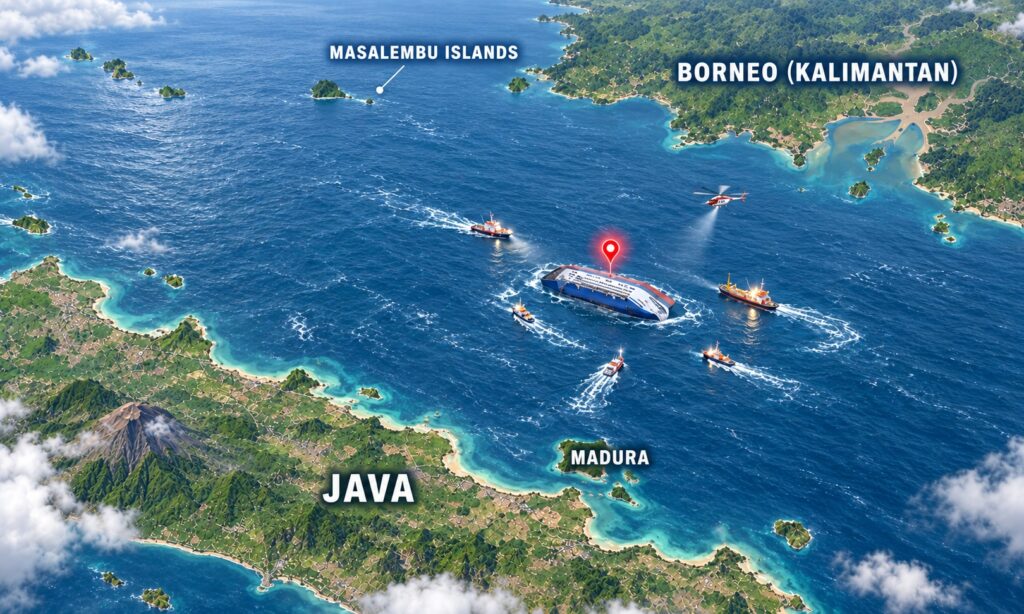
BANJARMASIN, Indonesia — Rescue crews searched through rough seas on Sunday night for 130 people still missing after a passenger-and-vehicle ferry overturned in the Java Sea, leaving at least six people dead and exposing, once again, the persistent dangers surrounding maritime travel in Indonesia.
The Virgo Transport 8 was carrying 243 passengers, crew members and other personnel from Surabaya, East Java, to Banjarmasin in South Kalimantan when it encountered severe weather near the Masalembo waters. By Sunday evening, officials said 107 people had been rescued alive and six bodies recovered. The figures remained provisional as authorities compared the passenger manifest with rescue and family reports.
A Distress Call in Heavy Seas
The captain reported deteriorating weather around midnight and told the operator at approximately 2 a.m. that the vessel was listing. The Banjarmasin Search and Rescue Office received the operator’s report at about 4:10 a.m., according to Indonesian officials.
The ferry’s last recorded position was roughly 80 nautical miles, or 148 kilometers, from the Basirih rescue pier in Banjarmasin. Survivors were picked up by tugboats and commercial vessels already in the area, illustrating how passing ships often become the first line of rescue across Indonesia’s vast maritime territory.
Basarnas, Indonesia’s search-and-rescue agency, deployed rescue ships, a helicopter and personnel supported by the Indonesian Navy, maritime authorities and civilian vessels. Transport Minister Dudy Purwagandhi traveled to the command center at Trisakti Port, where families gathered for verified passenger lists and updates. Authorities said the cause remained under investigation, including possible weather, technical and human factors.
Weather Was a Trigger, but Not Yet an Explanation
The captain reportedly encountered waves approaching three meters before the vessel overturned. That establishes the immediate conditions surrounding the emergency, but not its underlying cause. Investigators will need to examine the ferry’s stability, vehicle distribution and securing, maintenance record, emergency procedures and the decisions made before and after the weather deteriorated.
The Virgo Transport 8, a Japanese-built roll-on/roll-off passenger ship, entered service in 1987, according to vessel-tracking records. Its age does not by itself establish that the ship was unsafe, but it makes the condition of its structure and machinery an important line of inquiry.
The roughly two-hour interval between the captain’s last reported communication and the rescue office’s notification is also likely to face scrutiny. Officials have not said that the interval materially affected the outcome, and the precise communications timeline has yet to be independently established.
A Wider Regional Warning
Indonesia’s geography—more than 17,000 islands—makes ferries an essential and comparatively affordable part of everyday transportation. But incomplete manifests, uneven enforcement and the difficulty of supervising thousands of routes can turn an emergency into an accounting crisis, leaving rescuers uncertain about how many people they must find.
The International Maritime Organization has identified centralized digital passenger manifests and stronger controls against overcrowding as priorities for Indonesia and other Southeast Asian ferry systems.
Sunday’s accident also followed a succession of deadly incidents in the region. Four days earlier, the MV June Aster caught fire near Palawan in the Philippines. The death toll from that disaster had reached 76 by Sunday, with 13 people still missing, reinforcing concerns that weather monitoring, evacuation readiness and enforcement remain uneven across heavily traveled Southeast Asian sea routes.
Advice for Travelers
Travelers planning ferry journeys between Java and southern Kalimantan should confirm departures directly with the port authority or operator and allow for cancellations or significant delays. There was no announcement that every regional ferry route had closed, but conditions warranted caution.
Indonesia’s meteorological agency forecast waves of 1.25 to 2.5 meters across the western, central and eastern Java Sea from Sept. 14 through Sept. 17, with some of the country’s strongest winds expected over the Java Sea. Similar wave conditions were forecast near Banjarmasin.
Passengers should postpone nonessential crossings when marine warnings are active, ensure their names are correctly entered on the manifest and locate life jackets and emergency exits immediately after boarding. Anyone seeking a relative believed to have been aboard the Virgo Transport 8 should rely on verified lists issued through the official command post at Trisakti Port rather than social-media reports, as casualty and survivor totals are still changing.