
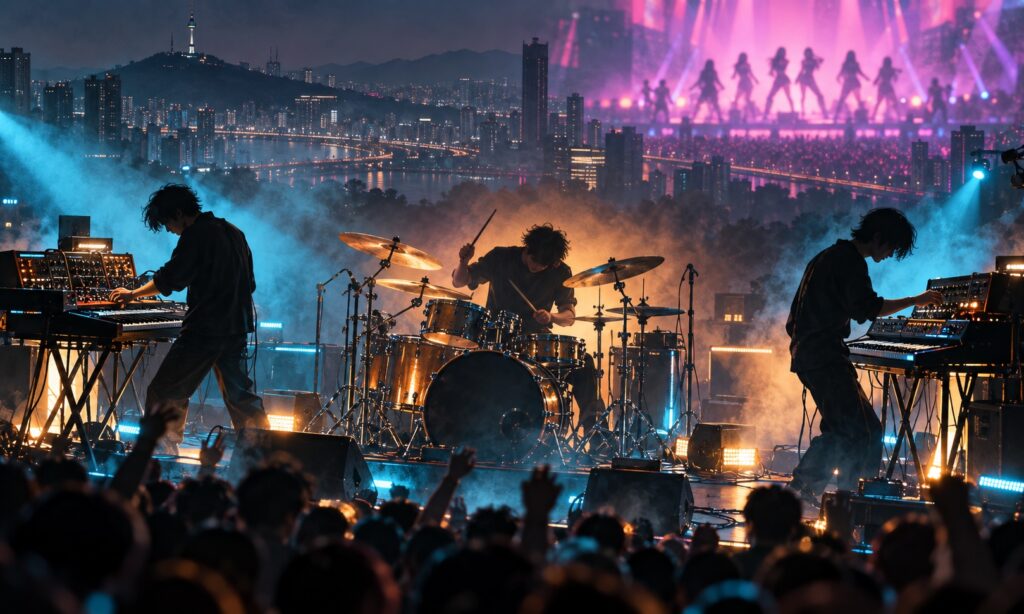
SEOUL, South Korea – On November 14, 2026, IDIOTAPE plan to celebrate their fourth album, “SUBHUMAN,” with a release show at Seoul’s Musinsa Garage. For the group, formed in 2008, the announced performance marks another chapter in a remarkably sustained career: they have won major Korean music awards and performed at prestigious international festivals. Yet their presence in Western pop consciousness remains far smaller than that of K-pop’s biggest names.
Their story begins in Seoul’s club scene. Producer and DJ Dguru and synthesizer player Zeze initially worked with a guitarist. After his departure, former Sugar Donut drummer DR joined in early 2010. This established their defining lineup: two musicians on electronic instruments and one on acoustic drums. The group had already performed at Global Gathering Korea in 2009; their debut EP, “0805,” followed in 2010.
Their rise soon took them abroad. In 2011, IDIOTAPE performed at Canadian Music Week, the American music industry festival SXSW and Japan’s Summer Sonic. Their first album, “11111101,” won the Korean Music Award for Best Dance and Electronic Album in 2012. “Tours,” released in 2014, was followed by a European tour in 2015, with appearances at Glastonbury, Fusion and Exit. Their third album, “Dystopian,” earned them the Korean genre award again in 2018. The jury also praised the social criticism embedded in their instrumental music.
They reached audiences beyond the concert stage, too: “Melodie” became known through the television show “The Genius” and the game “FIFA Online 3.” Their success thus rests on several foundations—award-winning albums, a powerful live presence and music that finds new listeners through other media.
International Recognition, Limited Mainstream Reach
Why has this not translated into fame comparable to that of international K-pop stars? There is no single, demonstrable explanation. Their career does, however, suggest a structural difference: IDIOTAPE primarily build their audience through their music and performances on the festival and club circuit. The global success of idol K-pop is additionally supported by a tightly integrated system of entertainment companies, choreography, a steady stream of video content and highly active fan communities. Studies of K-pop’s international spread emphasize precisely this combination of professional production and social networking.
IDIOTAPE largely lack the sung choruses and choreographed group performances that lend themselves so readily to circulation within the idol industry. Their instrumental music crosses language barriers, but offers different ways for listeners to connect. An electrifying festival performance can win new followers without automatically creating a lasting, internationally mobilized fan base. This is a plausible explanation for the difference in reach, rather than evidence of a weakness in the band’s marketing.
IDIOTAPE have experienced firsthand how these audiences do not necessarily overlap. In a 2014 interview with Korean Indie, they recalled an SXSW performance before numerous fans of HyunA and Jay Park, who initially stood waiting with their arms folded. Concert cancellations caused by visa problems were also part of their early experiences abroad. Building an international presence took considerable effort.
Describing them as a hidden gem known exclusively to electronic music fans would nevertheless be too narrow. Their festival history extends well into the rock and indie scenes. Dguru described this position between genres in 2015: abroad, the band tended to be perceived as electronic music; in Korea, more as rock. Their recognition is therefore more closely tied to particular music scenes than to the broader interest in Korean pop culture.
Electronic Instruments, Rock-Band Energy
For German listeners, comparisons with Kraftwerk and Tangerine Dream come naturally. Yet the three bands pursue different musical approaches. Kraftwerk’s defining sound draws on spare, precise motifs, electronic rhythms and a carefully conceived relationship between humans, machines and modern everyday life. In a 1991 interview, Ralf Hütter explained that machine-generated rhythmic patterns and Düsseldorf’s industrial surroundings formed part of the foundation of their music.
IDIOTAPE place greater emphasis on the physical dynamics of a rock band: the drums propel the music, synthesizers serve as cutting riffs, and repetition builds into powerful surges. As a musical comparison, one might say that Kraftwerk turn precision and restraint into expressive devices, while IDIOTAPE often explore the tension between electronic repetition and explosive band energy. This describes their characteristic approaches, rather than every recording across their respective careers.
Tangerine Dream, meanwhile, became particularly influential in the 1970s through extended instrumental developments, floating soundscapes and interlocking sequencer patterns. This so-called Berlin School often creates expansive musical spaces. By comparison, IDIOTAPE generally sound more immediate, more rhythmically concentrated and more focused on the energy of a dancing crowd. What they share is an exploration of electronic sound and the hypnotic effect of repetition.
Speaking to UnitedKpop in 2015, Zeze, IDIOTAPE’s synthesizer player and songwriter, explained: “We were initially heavily influenced by electronic live bands such as The Chemical Brothers and Soulwax.” He also pointed to the rock music of their youth. This combination offers a direct explanation of the trio’s approach: electronic instruments played with the musical mindset and energy of a rock band. An indirect legacy of Germany’s electronic pioneers is conceivable; a specific, personal line of influence would remain speculative without further statements from the musicians.
The announced “SUBHUMAN” show draws attention to a Korean success story that has unfolded over almost two decades. IDIOTAPE embody the staying power of a band whose international recognition exceeds its wider fame—and whose music makes the most sense where it first took shape: in the direct exchange between musicians, machines and an audience.